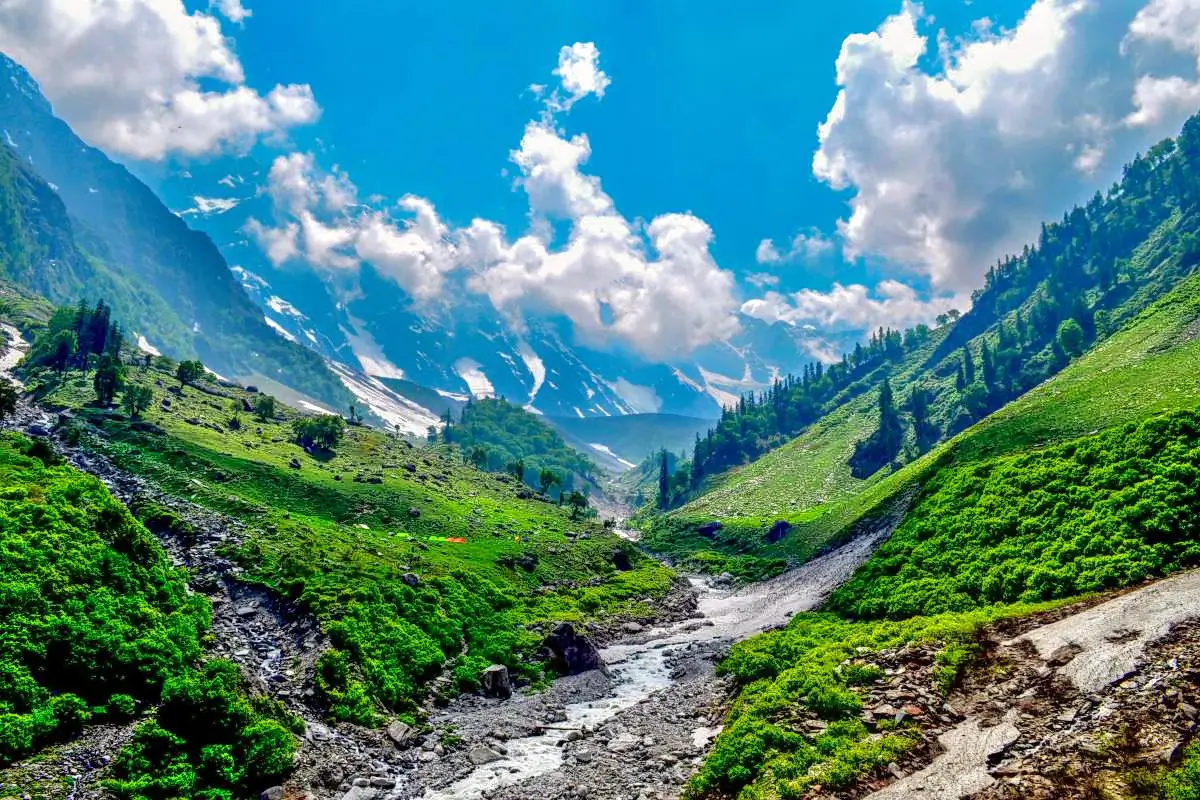

Stand at the edge of Beas Kund on a clear morning and try to count the peaks surrounding you. You'll lose count. Friendship Peak, Hanuman Tibba, Shitidhar, Ladakhi, the Seven Sisters - they rise from the ridge in a continuous dramatic arc, snowfields gleaming, their reflections shifting in the still surface of the glacial lake below. The Beas River, which you have been following upstream since you left Dhundi, starts here - emerging from beneath a glacier in a thin, cold thread that will grow into one of North India's great rivers by the time it reaches the plains. The scale of what surrounds you at Beas Kund is genuinely humbling. And the remarkable thing is that you reach this place in just four days from Manali.
The Beas Kund Trek sits in the Kullu district of Himachal Pradesh, beginning from Dhundi - a small hamlet at the end of the motorable road from Solang Valley, approximately 22 km from Manali. The trail follows the Beas River upstream through some of the most beautiful valley terrain in the region: dense mixed forests of pine, walnut, oak, and silver birch giving way to open high-altitude grasslands, then rocky moraines, and finally the glacial terrain of the Beas Kund basin itself. The entire journey unfolds gradually and naturally, with no sudden altitude gains that would challenge the body, and no technically difficult sections that would require prior mountaineering experience.
What makes this trek special beyond its visual impact is its dual identity. For the trekking community, Beas Kund is the base camp for three of Himachal Pradesh's most celebrated mountaineering objectives: Friendship Peak (5,289m), Shitidhar (5,120m), and Ladakhi Peak (5,345m). Mountaineering institutes train students in snow and ice craft in the meadows around Lohali and Lady Leg above the lake. Trekkers who visit Beas Kund are therefore walking into a landscape that professionals in serious expedition gear also call home - and this lends the place an aura that purely tourist destinations simply don't have.
For mythology, the lake is named after Rishi Vyas (also known as Beas Rishi or Veda Vyasa) - the revered sage credited with composing the Mahabharata and organising the Vedas. The word "Beas" itself is a Sanskritised form of "Vyas," and "Kund" means a small sacred pool or pond. Local communities in the Kullu valley maintain the sanctity of the lake and the surrounding area with genuine reverence - a cultural dimension to the trek that enriches the experience considerably.
The trail passes through the beautiful Bakarthach meadow - a wide, flat expanse of alpine grass that opens up unexpectedly after the forest section, with unobstructed views of Deo Tibba and Indrasan in the distance. In summer, wild strawberries grow along the trail. Himalayan monal (the state bird of Himachal Pradesh), bar-headed geese, and yellow-billed choughs are commonly spotted. Herds of sheep and goats graze the high pastures. There is a wildness to Beas Kund's landscape that more heavily trafficked Himalayan treks have lost - and this, as much as anything, is what keeps trekkers returning.
Drive: Manali to Solang Nallah - 14 km | ~45 mins | Trek: Solang Nallah to Dhundi - ~8 km | 4-5 hrs
Your Beas Kund journey starts from Manali, heading northwest toward the adventure hub of Solang Nallah - Manali's famous base for skiing, paragliding, and now your Beas Kund trek. After a short drive, the trek begins here. The trail moves steadily upward through lush green meadows and patches of dense forest, following the right bank of the Beas River deeper into the Solang Valley.
The path to Dhundi is an 8 km walk that gradually introduces you to the Himalayan landscape at your own pace - no steep walls, no difficult terrain, just a long and pleasant climb through birch, pine, and walnut groves with the mountains slowly revealing themselves above the treeline. The sound of the Beas River accompanies you for much of the walk, and the valley's wildness grows noticeably the further you go from Solang.
Dhundi (2,840m) is a tranquil camping spot set right beside the Beas River - and the moment you arrive, the contrast with the bustle of Manali is total. Mountains on all sides, the river running cold and fast beside camp, and a silence that feels earned. Set up tents, settle in, and let the first evening in the high Himalayas work its quiet magic.
Overnight: Camping tents at Dhundi | Meals: Lunch and Dinner
Trek: ~5 km | ~4 hrs
The second day begins with a warm breakfast at the Dhundi camp before the trail heads further upstream toward the heart of the valley. The path from Dhundi to Bakarthach is one of the most visually generous stretches of the entire trek - open alpine terrain, the valley widening ahead, and the peaks growing more pronounced with every metre of altitude gained.
The trail passes through rocky sections and, depending on the season, patches of snow that linger long into summer at this elevation. The gradient is steady and manageable - a good climbing day that builds altitude gradually without punishing the legs. As you gain height, the treeline drops away behind you and the meadow country of the upper valley takes over completely.
Bakarthach (3,270m) arrives like a gift. An open, flat alpine campsite ringed by snow-capped peaks, with the Seven Sisters rising to the north and Deo Tibba (6,001m) and Indrasan (6,221m) visible to the south. The quality of light at this altitude in the late afternoon is something photographers spend careers chasing - warm, directional, and almost golden against the white summits. Camp here, rest your legs, and go to bed early with your alarm set.
Overnight: Camping tents at Bakarthach | Meals: Breakfast, Lunch and Dinner
Trek: ~5–6 km return | ~8 hrs
This is the summit day - the day the entire trek has been building toward - and it asks the most of you in return for the most it gives back.
After an early breakfast, leave camp and begin climbing through increasingly dramatic terrain. The meadows thin, the boulders grow in size and frequency, and the peaks close in on both sides as the valley narrows toward its upper reaches. The trail passes through the Lohali campsite area - a natural hollow between two ridges where Friendship Peak (5,289m) and Shitidhar (5,120m) rise directly overhead, and where mountaineering institutes regularly train students in snow and ice technique. On clear mornings, roped teams moving on the snow slopes above are a sight that puts the scale of what surrounds you in immediate perspective.
Above Lohali, the terrain transitions to moraine - loose boulder fields deposited by retreating glaciers - and the trail crosses a small ridgeline before the valley on the far side reveals itself. And there it is: Beas Kund. The first glimpse of the lake - its water shifting between deep emerald and bright aquamarine, partially frozen even in midsummer, cradled in a rocky glacial bowl beneath the hulking walls of Hanuman Tibba (5,982m) - tends to stop trekkers where they stand. The source of the mighty Beas River, resting quietly in this high stone cradle, is a genuinely moving sight.
Spend as long as possible at the lake. Walk its perimeter, photograph the peaks reflected in its surface, and sit with the silence - this is one of the few places in the Indian Himalayas that still feels genuinely untouched. The lake is considered sacred by local communities; treat it with corresponding respect - no littering, no loud music, and no swimming or washing in or near the water.
For those with extra time and energy, the route continues further to Lady Leg - the base camp for Friendship Peak expeditions - offering an even closer encounter with the high peaks and their glaciers.
Descend by the same trail to Bakarthach camp in time for dinner under the stars.
Overnight: Camping tents at Bakarthach | Meals: Breakfast, Lunch and Dinner
Trek: ~9 km | ~5–6 hrs | Drive: Solang Nallah to Manali - 14 km | ~45 mins
The final day is a longer descent - approximately 9 km back to Solang Nallah - but the trail is familiar now, the legs are properly trail-hardened, and the walk carries the pleasant, reflective quality of a journey coming full circle. Break camp after a final breakfast with Deo Tibba and Indrasan overhead, and begin descending through Dhundi and back down the valley to Solang Nallah.
The route passes all the landmarks of the first day in reverse - the birch and walnut forests growing denser as altitude drops, the Beas River reappearing louder and broader below, and the ski slopes and activity centres of Solang Nallah signalling the return to the world you came from. It typically takes around 5-6 hours to reach Solang Nallah at a comfortable pace, arriving in the afternoon.
From Solang Nallah, transport back to Manali takes under an hour. The afternoon in Manali is free - the Mall Road, the ancient Hadimba Devi Temple set in its cedar forest, the natural hot springs at Vashisht Village, or simply sitting by the Beas River with a warm cup of chai and the knowledge that you've walked to its source and back.
Overnight: Hotel in Manali (optional, at extra cost) or departure | Meals: Breakfast, Lunch and Dinner
Spring - May to June ★★★★★ Arguably the best season. Snow is melting off the peaks, the meadows burst into vivid green, wildflowers bloom across Bakarthach, and the Beas Kund lake has its most dramatic contrast of blue water against white snowfields. Temperatures are comfortable during the day (10-18°C) and cold at night (0-5°C). This is the ideal time for photographers and nature lovers.
Monsoon - July to August ★★★★☆ Surprisingly, the Beas Kund Trail holds up well in monsoon compared to many other Himalayan treks - the Solang Valley receives less rainfall than the Dhauladhar belt, and the trail remains largely walkable. Alpine flowers are at their most profuse, the meadows are lushest, and the crowds are lower. However, trails can be slippery after rain, and stream crossings may be more challenging. A rewarding season for experienced trekkers prepared for variable conditions.
Post-Monsoon Autumn - September to October ★★★★★ Crystal-clear post-monsoon skies offer the sharpest mountain visibility of the year. The Pir Panjal peaks are immaculate white against a deep blue sky, and the meadows take on golden autumn tones. Temperatures are comfortable and stable. October is widely considered the finest single month for the Beas Kund Trek.
Winter - November to April ✗ The trail is generally inaccessible. Heavy snowfall and avalanche risk in the Solang Valley and above Dhundi make the trek dangerous and unsuitable for regular trekkers. Not recommended.
Included:
Not Included:
Clothing: Sturdy waterproof trekking shoes (ankle support essential - terrain is rocky and uneven), moisture-wicking base layers (full-sleeve), warm mid-layer fleece, down jacket or heavy insulated jacket (nights drop to 0°C even in summer), trekking pants (quick-dry), waterproof windbreaker, warm hat, gloves, and woollen socks (two pairs minimum).
Equipment: 30-40 litre trekking backpack, 2-litre water carrying capacity (water sources available on trail but glacier water should be treated), trekking poles (highly recommended - rocky descents are significantly easier with poles), headlamp and spare batteries, sunglasses (UV protection essential at altitude), high-SPF sunscreen, personal first aid including blister plasters and any regular medications.
Personal: Valid government photo ID, cash in small denominations (no ATMs beyond Manali - withdraw before departure), personal medicines, lip balm, hand sanitiser, toilet paper, power bank, camera with spare batteries/memory.
Trek Starting Point: Dhundi, Solang Valley - 22 km from Manali via Solang Nallah. Your TriptoOcean team arranges shared jeep transport from Manali to Dhundi and back as part of the package.
By Road from Delhi: The most popular route. Delhi to Manali is approximately 540 km via NH 3, taking 12-14 hours by bus or private vehicle. Overnight Volvo buses from ISBT Kashmere Gate, Delhi depart daily at 5-6 PM and arrive in Manali early morning (₹1,000-2,000 per person). Pre-book via HRTC website or RedBus. Note: The Mandi-Manali stretch of NH 3 is prone to landslides - build extra buffer time into your travel plans.
By Road from Chandigarh: 310 km, approximately 8-10 hours by road. Regular buses and shared taxis available from Chandigarh's ISBT.
By Air: Nearest airport is Bhuntar (Kullu-Manali Airport) - 52 km from Manali. Flights from Delhi operate daily via IndiGo and Air India (approximately 1 hour, ₹3,000-7,000). From Bhuntar, taxis to Manali cost ₹700-1,000.
Note: Mountain weather frequently disrupts flights, always have a road travel backup plan.
By Train: No direct rail connection to Manali. Nearest major railway stations are Chandigarh (310 km) or Pathankot (325 km). From either, take a bus or taxi to Manali. The narrow-gauge Kalka-Shimla Heritage Railway connects Kalka to Shimla - a scenic option if you're combining a Shimla visit.
Recommended Arrival: Reach Manali the evening before Day 1 of the trek. This gives you a buffer for travel delays, time to acclimatise to Manali's altitude of 2,050m overnight, and an opportunity to buy any last-minute supplies from Manali's trekking gear shops on Mall Road.
Yes - the Beas Kund Trek is one of the most recommended first high-altitude treks in Himachal Pradesh. The altitude gain is gradual across four days, the trails are well-defined, and the maximum altitude of 3,700m is achievable for most healthy adults without acclimatisation concerns. The daily walking time is 4-6 hours at a steady pace. If you can comfortably walk 8-10 km on flat ground, you can do this trek with proper preparation.
The highest point is Beas Kund lake at approximately 3,700 metres (12,139 ft). At this altitude, some trekkers may experience mild symptoms - headache, breathlessness, fatigue - particularly if they have not spent a night at Manali's altitude (2,050m) before starting. TriptoOcean strongly recommends arriving in Manali one day before the trek to acclimatise overnight. The gradual ascent over four days is specifically designed to minimise altitude-related issues.
The Beas Kund Trek offers some of the finest base-to-summit mountain views available on any short Himalayan trek. Visible peaks include Friendship Peak (5,289m), Hanuman Tibba (5,982m), Shitidhar (5,120m), Ladakhi Peak (5,345m), the Seven Sisters range, Deo Tibba (6,001m), and Indrasan (6,221m). The setting at Beas Kund itself - completely enclosed by the Pir Panjal peaks - is one of the most dramatic mountain amphitheatres in the Kullu Valley.
The lake is named after Rishi Vyas (also Maharishi Vyasa or Veda Vyasa) - the revered Hindu sage credited with composing the Mahabharata, organising the Vedas, and authoring the Puranas. According to local legend, the sage meditated here and is said to have bathed in this glacial lake during his time in the Kullu Valley. The word "Beas" itself derives from "Vyas," and the river that originates at this lake carries his name throughout its course. The lake holds active religious significance for local communities in the Kullu valley.
Yes. A forest permit and camping fee are required for this trek as the route passes through protected forest land. TriptoOcean handles all permit arrangements as part of the package - you do not need to arrange these separately. Carry your valid government photo ID (Aadhaar or passport) as it is required at checkpoints along the trail.
The trek is best done between May and October. May-June offers the finest combination of clear skies, blooming meadows, and dramatic snowfields at the lake. September-October provides the sharpest mountain visibility after monsoon. July-August works for experienced trekkers comfortable with rain and variable conditions. The trek is not recommended from November to April due to heavy snowfall and avalanche risk above Dhundi.
The Beas Kund trail passes through rich Himalayan biodiversity.
Commonly spotted birds include the Himalayan monal (state bird of Himachal Pradesh, with spectacular plumage), bar-headed geese, yellow-billed choughs, magpies, and various warblers. Herds of sheep and mountain goats graze the upper meadows. Himalayan black bears inhabit the lower forest sections but sightings are extremely rare, especially with a group of trekkers.
Your TriptoOcean guide will brief you on wildlife awareness on Day 1.
Yes. The Beas Kund Trek is considered safe for solo women travellers, particularly when booked through an organised operator like TriptoOcean.
Our guided groups maintain a comfortable gender ratio and all camp arrangements ensure privacy. Female trekkers share tents only with other women. The trail is not isolated - Solang Valley is one of Manali's busiest areas and the route is regularly trekked. Contact TriptoOcean before booking to discuss group composition and specific requirements.
The trek involves 4-6 hours of walking per day over mixed terrain - forest paths, open meadows, rocky moraines, and some steep sections. A 4-6 week preparation routine is recommended: daily walks of 5-8 km building up to longer distances over weekends, stair climbing (3-4 floors at a brisk pace, repeated 5-10 times), and light cardio such as cycling or swimming.
ore strength exercises help with balance on rocky sections. Most importantly: if you wear new trekking shoes, break them in over 2-3 weeks of regular walking before the trek.
A shorter 3-day / 2-night version is available and TriptoOcean does offer this option - Day 1 trek from Solang Nallah to Dhundi, Day 2 Dhundi to Bakarthach and onward to Beas Kund summit and back, Day 3 descent to Solang Nallah and return to Manali. However, this compressed version is noticeably more demanding and significantly less enjoyable than the standard 4-day format.
The 4-day itinerary is strongly recommended for first-time high-altitude trekkers for three practical reasons: the gradual day-by-day altitude gain allows your body to acclimatise properly before the summit push; the pace is comfortable enough to actually absorb the landscape rather than just move through it; and splitting the approach across two days means you arrive at Bakarthach rested, rather than tired from a longer combined day. The 3-day version works for trekkers with some prior high-altitude experience and limited time. For everyone else, the extra day makes a meaningful difference to both safety and the quality of the experience.