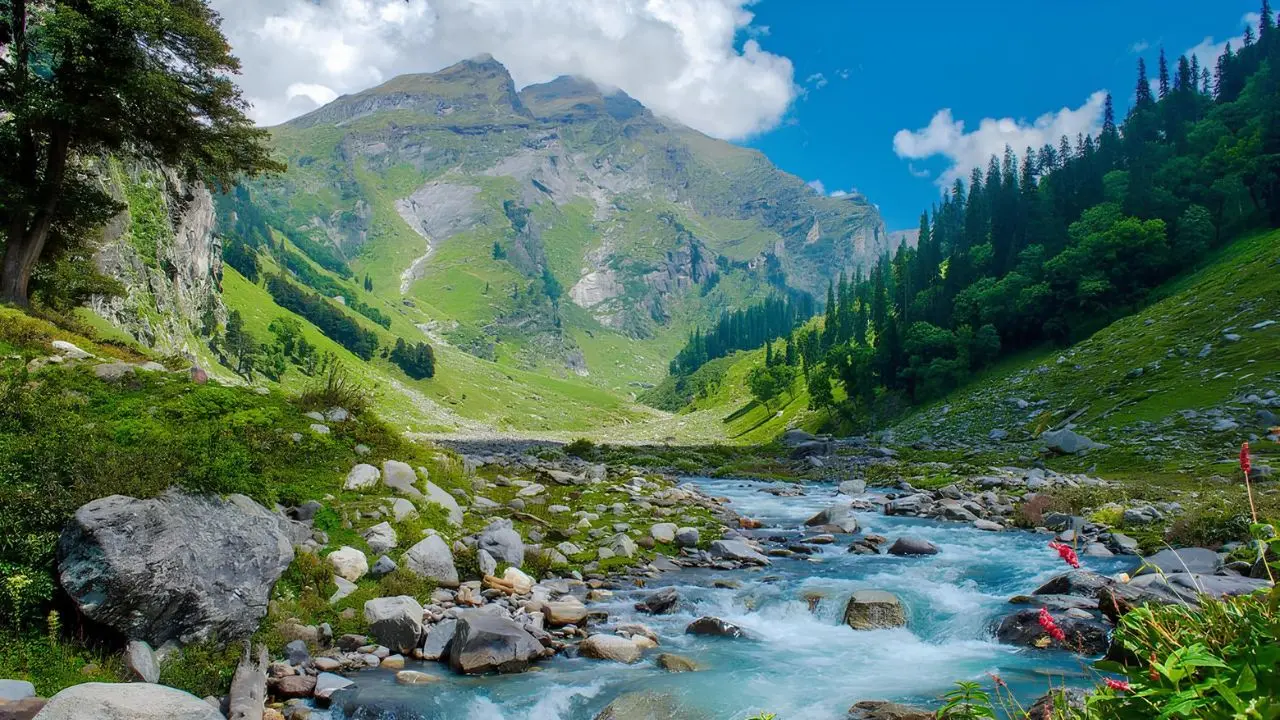

There are treks that take you through beautiful scenery. And then there are treks that change the way you see the Himalayas. The Hampta Pass Trek belongs firmly in the second category. It is, at its core, a story of contrast - one of the most dramatic geographical contrasts available in the entire Indian Himalayan trekking landscape. In under five days, walking approximately 26 kilometres from the village of Jobra near Manali, you pass through forests, river valleys, wildflower meadows, glacial moraines, a high-altitude mountain pass at over 14,000 feet, and an ancient cold desert - all of them entirely different in character, colour, and atmosphere.
The pass itself - Hampta Pass, 4,270 metres above sea level - sits on the Pir Panjal Range of the Himalayas and connects the Kullu Valley to the Lahaul Valley. It has been used for centuries by shepherds, traders, and travellers moving between these two valleys. What makes it extraordinary is the violence of the transition it represents. The Kullu side is a monsoon-fed ecosystem: dense forests, roaring rivers, alpine meadows packed with wildflowers, and the rich biological diversity of the Pir Panjal rain belt. The moment you cross the pass and look north toward Lahaul, all of that disappears. The rain shadow of the Himalayan range keeps Lahaul near-desert - bare brown peaks, dry riverbeds, scoured rock, and a vast, silent emptiness that is beautiful in an entirely different way.
The route from Jobra follows the Rani Nallah river upstream - a constant companion through the trek's early days - climbing past the Chika campsite and into the spectacular Jwara meadow, often called Himachal's Valley of Flowers for the density and variety of wildflowers that bloom here through the monsoon. Above Jwara, the valley opens into the Balu Ka Ghera campsite - a wide, sand-floored glacial basin beneath towering snow peaks - where you spend the night before the pass crossing day. Looking up from Balu Ka Ghera in the early morning, with Deo Tibba (6,001m) and Indrasan (6,221m) visible on the horizon and the Hampta Pass somewhere above you in the mist, the sense of anticipation is considerable.
Pass day is the longest and most physically demanding day of the trek - about 7–9 hours covering 9 km, ascending steeply through boulders, moraine, and snowfields to the pass before a challenging descent to Shea Goru on the Lahaul side. It is a day that tests your legs, your lungs, and your resolve. It is also the day that almost every Hampta Pass trekker names as the highlight of the journey. The views from the pass - Deo Tibba and Indrasan close and massive, the Kullu Valley spreading green and distant below, the brown Lahaul ridges ahead - are a sight of genuine grandeur.
The trek ends at Chhatru, from where a drive takes you to Chandratal Lake (4,250m) - a crescent-shaped glacial lake in the Spiti region whose Sanskrit name means "Moon Lake." The lake's colour is extraordinary: a deep, shifting turquoise that changes from blue to green to silver through the day, surrounded by bare desert mountains and an enormous sky. Hindu mythology connects Chandratal to the Mahabharata - the lake is said to be the spot from which the Pandava king Yudhishthira ascended to heaven. Whether or not you carry that association with you, the experience of reaching Chandratal at the end of a five-day trek and sitting beside those still waters in the late afternoon light is one that stays with trekkers for decades.
The Hampta Pass Trek is graded moderate - accessible to fit beginners who prepare properly, but genuinely challenging enough that it earns its difficulty rating. The first two days are relatively easy; summit day is long, cold, and demands real stamina. Come prepared, go with good guides, and you will cross one of India's finest mountain passes and arrive in a completely different world.
Drive: Manali to Jobra - 18 km | ~1-1.5 hrs | Trek: Jobra to Chika - 3 km | 2-3 hrs
The Hampta Pass Trek begins with a morning briefing in Manali and a scenic drive to Jobra - the roadhead for the trek, nestled in the Hampta Valley at 2,743 metres. The road from Manali winds through the famous 42 hairpin bends of the Hampta Valley road, offering increasingly dramatic views of the Kullu Valley and the Beas River below. Each bend climbs deeper into the mountains, and by the time you reach Jobra, the valley has narrowed, the peaks have closed in, and the air has sharpened.
The trek begins at Jobra. The first section of trail passes through a beautiful mixed forest of deodar, maple, oak, and silver birch - classic Kullu Valley woodland, damp and cool and full of birdsong. The Rani Nallah river runs nearby, its sound a constant companion through the early part of the trek. After a gradual climb of approximately 3 km, you arrive at the Chika campsite (3,100m) - a wide green meadow beside the river, framed by forested ridgelines on all sides. This is an ideal first camp: spacious, well-placed, and a perfect warm-up for the days ahead.
The evening at Chika is gentle and beautiful - set up tents, have dinner, and watch the night sky deepen over the valley.
Overnight: Camping at Chika | Meals: Dinner
Trek: ~8-9 km | 5-6 hrs
This is the day the trek reveals its extraordinary character. Leaving Chika after breakfast, the trail initially climbs through more forest sections before the valley opens dramatically. The Rani Nallah grows louder as you follow it upstream, and the first river crossing of the trek appears approximately 2.5 km in - a proper wade through glacially cold, knee-deep water. The crossing is exhilarating in the way only icy mountain water can be, and your guide will assist with the group crossing safely.
Beyond the crossing, you step into the famous Jwara meadow - and the change is immediate and extraordinary. The forest vanishes and a vast alpine amphitheatre opens before you: a wide grassy bowl packed with wildflowers in every direction. Dozens of species bloom here through the season - yellow and pink and purple and white - and on monsoon days when the mist rolls in and out of the valley, the meadow has an otherworldly, Valley-of-Flowers quality that stops trekkers mid-stride. This is what many describe as the single most beautiful camp-to-camp stretch of the entire trek.
Past Jwara, the trail's character shifts again. The meadow gives way to rocky, sandy terrain as you approach Balu Ka Ghera (3,600m) - whose name literally means "sand bed." The campsite sits in a wide glacial basin at the foot of the mountains you will cross tomorrow. Boulder fields and sand mark the valley floor; on either side, the ridgelines rise steeply toward the Pir Panjal crest. From here, Hanuman Tibba is visible, and looking further, the route to Hampta Pass is somewhere above you in the grey-brown rock. Camp here, eat well, sleep early - tomorrow is the day the trek earns its reputation.
Overnight: Camping at Balu Ka Ghera | Meals: Breakfast, Lunch, Dinner
Trek: ~9 km | 8-10 hrs | THE SUMMIT DAY
This is the day. Start early - 6:00-6:30 AM. The first section from Balu Ka Ghera follows the Rani Nallah upstream through a boulder-strewn zigzag path. The terrain is rocky, the gradient is increasing, and the valley is narrowing on both sides. Above 2 km from camp, the trail gets significantly steeper. The river thins to a thread, the last vegetation disappears, and the trail enters a world of snow and rock. The air is colder and thinner at this point, and the pace naturally slows. Keep it steady and rhythmic - this is not a race.
The final climb to Hampta Pass is steep and relentless, involving ledge after ledge of bouldery moraine and, in June and July, substantial snowfields requiring careful footing. Trekking poles are essential here. The sense of anticipation builds with every metre of elevation gained - and when you finally crest the pass and step onto the small plateau at the summit, the reward is immediate and overwhelming.
Hampta Pass at 4,270 metres. Behind you: the green Kullu Valley, impossibly far below. Ahead: the brown, bare, vast expanse of Lahaul stretching to the horizon. Deo Tibba (6,001m) and Indrasan (6,221m) dominate the skyline directly ahead - closer and more massive from the pass than they've appeared at any point on the trek. Take your time at the summit. Photograph it, absorb it, earn the moment. You've crossed the Himalayas.
The descent from Hampta Pass toward Shea Goru is steep, long, and technically demanding - approximately 50-degree slopes of loose rock, shale, and (in June) snow. It takes 2-2.5 hours and requires careful, slow movement with trekking poles. Below the steep section, the Lahaul valley opens into a wide, flat meadow dotted with flowers and bordered by a rushing glacial river - and here, almost impossibly, is Shea Goru camp. After the severity of the descent, the green meadow and the sound of running water feel like arriving somewhere genuinely magical.
Overnight: Camping at Shea Goru | Meals: Breakfast, packed lunch at pass, Dinner
Trek: ~5-7 km | 3-4 hrs | Drive: Chhatru to Chandratal and back - ~100 km | 3-4 hrs each way
The fourth day begins with the distinctive atmosphere of Lahaul - dry, cool, vast, and deeply quiet. The trail from Shea Goru to Chhatru descends gradually along the Shagaru River for approximately 5-7 km through increasingly barren landscape. The contrast with the Kullu Valley side of the trek is total: no trees, no undergrowth, bare brown ridges under an enormous blue sky. The walk takes 3-4 hours and is physically easier than the previous day, allowing you to simply walk and process the landscape around you.
Chhatru is a small, temporary settlement at the meeting point of three great routes: Hampta Pass, Rohtang Pass, and the road into Lahaul and Spiti. From Chhatru, pending road and weather conditions, you board a vehicle for the drive to Chandratal Lake (4,250m).
The road to Chandratal passes through terrain that grows progressively more lunar - rocky plateaus, dried riverbeds, occasional nomadic camps, and a sky that is extraordinary in its unobstructed depth. After approximately 50 km and 3-4 hours of bumpy driving, Chandratal appears below a rocky ridge: a crescent of water so improbably blue in the middle of this brown desert that the first sight of it feels like a hallucination.
Chandratal - the Moon Lake. At 4,250 metres in the Spiti Valley, this glacial lake is one of the most beautiful bodies of water in India. Its colour shifts through the day from deep turquoise to silver-blue to emerald, its banks are perfectly clear, and its silence is the specific silence of high altitude - complete, clean, and profoundly restful. Hindu mythology places Chandratal as the lake from which Yudhishthira ascended to heaven in the Mahabharata. Its Ramsar wetland status reflects its ecological importance. Sit here as long as you can before the drive back to Chhatru.
Overnight: Camping at Chhatru | Meals: Breakfast, Lunch, Dinner
Drive: ~65 km | 5-7 hrs
The final day is a return journey that makes use of either the Atal Tunnel (the engineering marvel that connects Manali to Lahaul year-round through a 9-km tunnel at 3,000m) or the Rohtang Pass route depending on conditions and season. Either way, the drive back through the Lahaul and Kullu landscapes is a beautiful conclusion to the journey - a last sequence of mountain views before Manali's altitude and then eventually the noise and warmth of the town return.
Arrive back in Manali by late afternoon. The trek is complete.
Meals: Breakfast
June ★★★★☆ The trail opens in June and early season trekkers find substantial snowfields - especially on the summit day climb and descent. This transforms Hampta Pass into a proper snow trek. Microspikes are recommended. Views are dramatic, wildflowers are beginning to bloom, and the Kullu Valley is deeply green. Expect cold nights (-2°C to -5°C) and variable weather. For those who love snow, this is the most thrilling time.
July to August (Monsoon) ★★★★★ The finest time for the Hampta Pass Trek. The trail is fully open, Jwara meadow is at its most spectacular - hundreds of wildflower species in full bloom - and the Kullu Valley is its richest, most intensely green. Expect rain on some days, which adds atmosphere and occasionally drama, but rarely stops the trek. Views from the pass on clear days are extraordinary. This is the peak season for a reason.
September to Mid-October ★★★★★ Post-monsoon clarity means the sharpest mountain views of the year. The meadows transition from green to golden, the skies are consistently blue, temperatures are comfortable during the day, and the Lahaul landscape takes on an especially cinematic quality. Chandratal Lake is at its clearest and most beautiful. An excellent time for photographers and those who prefer drier conditions.
Late October onwards ✗ The route closes as snowfall returns to the pass. Not recommended.
Included:
Not Included:
Clothing - Essential: Sturdy waterproof trekking shoes with ankle support (non-negotiable - terrain is rocky, wet, and demanding), moisture-wicking base layers (full-sleeve, at least 2 sets), warm insulated mid-layer fleece, heavy down jacket (nights at Balu Ka Ghera and Shea Goru drop to -5°C), waterproof and windproof outer shell jacket and pants, trekking pants (2 pairs - quick dry), warm hat, balaclava, gloves, warm socks (3 pairs minimum). Do not carry cotton clothing - cotton retains moisture and accelerates hypothermia.
Equipment: 30-40 litre trekking backpack, trekking poles (essential - both for the steep ascent to the pass and the tricky descent on the Lahaul side), 2-litre water carrying capacity, headlamp and extra batteries, UV-protection sunglasses, high-SPF sunscreen and lip balm (UV intensity at altitude is extreme), first aid kit with personal medications.
Personal: Valid government photo ID (Aadhaar or passport - required at checkpoints), cash in small denominations (no ATMs beyond Manali), hand sanitiser, toilet paper, power bank, camera. Note: Mobile networks (Jio and BSNL) work in Manali but drop out completely after Jobra. Inform family before the trek.
Trek Starting Point: Jobra - 18 km from Manali via the Hampta Valley road. Your TriptoOcean team arranges shared vehicle transport from Manali to Jobra as part of the package. Arrive in Manali a day before Trek Day 1 to acclimatise and avoid delays.
By Road from Delhi: The most popular approach. Delhi to Manali is approximately 540 km via NH 3 - 12-14 hours by bus or private vehicle. Overnight Volvo buses from ISBT Kashmere Gate depart daily at 5–6 PM and arrive in Manali early morning (₹1,000-2,000). Pre-book via HRTC or RedBus. The Mandi-Manali stretch of NH 3 is prone to landslides June–September - always allow 2–3 hours' buffer in travel plans.
By Road from Chandigarh: 310 km, approximately 8-10 hours. Regular buses and taxis from Chandigarh's ISBT.
By Air: Nearest airport is Bhuntar (Kullu-Manali Airport) - 52 km from Manali. Daily IndiGo and Air India flights from Delhi (approximately 1 hour, ₹3,000-7,000). Taxi from Bhuntar to Manali: ₹700-1,000. Mountain weather frequently disrupts flights in monsoon - have a road travel backup.
By Train: No direct rail to Manali. Nearest stations: Chandigarh (310 km) or Joginder Nagar (160 km, narrow gauge). From either, bus or taxi to Manali. Most trekkers from Delhi prefer the overnight bus for its convenience and cost-effectiveness.
The Hampta Pass Trek is accessible to fit beginners but should not be underestimated. It is graded moderate - the first two days are manageable for most trekkers with reasonable fitness, but Day 3 (summit day) is genuinely demanding: a 9 km trek over 8-10 hours, steep ascent to 14,100 ft, and a steep technical descent on the other side. Prior trekking experience at altitude - even just one or two shorter Himalayan treks - significantly improves the summit day experience. If this is your first Himalayan trek, ensure 4-6 weeks of solid physical preparation.
The dramatic crossover - the shift from the lush, monsoon-fed Kullu Valley to the stark cold desert of Lahaul within a single day of trekking - is what makes Hampta Pass genuinely unique. Most Himalayan treks show you one type of terrain. Hampta Pass shows you two completely different ecosystems, two different geological worlds, separated by a single mountain pass. It is the most visually diverse short trek in Himachal Pradesh. Add Chandratal Lake at the end, and you have an experience that encompasses forests, meadows, river crossings, snowfields, a high pass, a cold desert, and one of India's most beautiful alpine lakes - all within five days.
Yes - and multiple permits are required. The trail passes through Inderkilla National Park, which requires a Forest Entry Permit from the Forest Department office in Manali. For the full route ending at Chhatru with a Chandratal visit, a vehicle permit is needed to cross the Rohtang/Jobra checkpost and a separate permit for Chandratal Lake entry. TripToOcean handles all permit arrangements as part of the package. Carry a valid government photo ID at all times.
Chandratal (4,250m) - literally "Moon Lake" - is a crescent-shaped glacial lake in the Spiti Valley, approximately 50 km by road from Chhatru. Its colour is an extraordinary shifting turquoise that changes through the day, its surroundings are bare desert mountains, and its silence is absolute. Hindu mythology connects it to the Mahabharata. It has Ramsar wetland protected status. Yes, it is absolutely worth the drive - for most trekkers, the first sight of Chandratal is the single most visually stunning moment of the entire trek. The visit is subject to road and weather conditions; TripToOcean will always attempt to include it.
The trek is a monsoon trek open June to mid-October. June offers snow trekking near the pass - dramatic but demanding. July-August is peak wildflower season in Jwara meadow and is widely considered the finest time. September-October offers the clearest post-monsoon skies and sharpest mountain views. All months within this window are valid choices depending on what you're looking for.
Temperatures vary significantly across the five days. At Chika (3,100m), nights are around 8-12°C. At Balu Ka Ghera (3,600m), nights drop to 0-5°C. At Shea Goru and Chhatru (3,350-3,900m), temperatures range from -2°C to 5°C at night. At Chandratal (4,250m), nights can drop to -5°C to -10°C even in summer. A quality sleeping bag rated to -10°C and multiple warm layers are non-negotiable.
The Hampta Pass Trek has multiple river crossings - the most significant being the Rani Nallah crossing between Chika and Balu Ka Ghera, which can reach knee-to-waist depth in peak monsoon. The water is glacially cold, the current is strong, and footing on the river bed is slippery. Your guide manages the crossings using human chains and ropes. Most trekkers describe the crossings as exhilarating - a combination of cold shock, laughter, and real physical engagement. Remove your shoes before crossing and dry your feet immediately after. Trekking poles provide crucial balance.
At 4,270 metres, altitude sickness (AMS) becomes a genuine risk on this trek - more so than on lower routes like Triund or Beas Kund. The symptoms - headache, nausea, loss of appetite, fatigue - can affect trekkers of any fitness level. TriptoOcean's guide team carries pulse oximeters, first aid, and supplemental oxygen. The key preventive measures are: arrive in Manali one day before the trek to acclimatise at 2,050m, stay well-hydrated, ascend at a steady pace, and inform your guide immediately if you feel any persistent headache or dizziness. Do not ignore AMS symptoms.
Technically, the roundtrip route from Jobra (without Chandratal) can be trekked solo, but this is not recommended for beginners. The full route crossing to Chhatru and visiting Chandratal involves vehicle permits and logistics that are significantly easier to manage through an organised group like TripToOcean. For solo travellers, TriptoOcean's group departures with other trekkers provide both safety and the social experience that makes multi-day camping treks memorable.
Begin a training routine at least 4-6 weeks before the trek. Daily cardio - jogging, cycling, or brisk walking for 45-60 minutes - builds the aerobic base needed for summit day. Stair climbing (4-6 floors, repeated 8-10 times) specifically trains the leg muscles used in the steep climb to Hampta Pass. Core strengthening helps with balance on rocky descents. If possible, complete one other moderate Himalayan trek (Beas Kund, Triund, Bhrigu Lake) before Hampta Pass - the acclimatisation experience and understanding of how your body responds to altitude is invaluable on summit day.