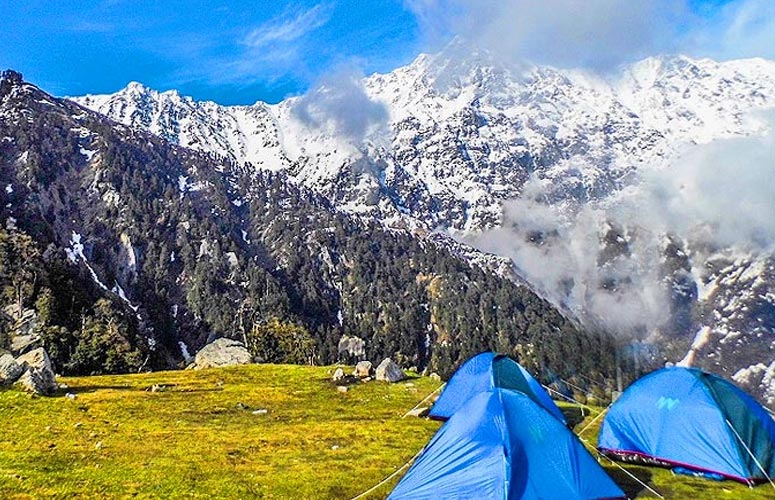

There's a point on the Triund trail - somewhere around the last two kilometres before the ridge - where the trees thin out and the Dhauladhar peaks appear for the first time in their full, staggering scale. Trekkers who have been half-focused on their footing, chatting with friends, or quietly working through the steady incline suddenly go quiet. The mountains do that. The jagged granite towers of Moon Peak, Rifle Horn, and the greater Dhauladhar massif seem close enough to touch - huge and ancient and indifferent, draped in snow even in summer - and the realisation that you've walked this close to them in just a few hours is genuinely disorienting in the best possible way.
The Triund Trek in Himachal Pradesh is arguably the most accessible high-impact Himalayan trekking experience in India. Starting just above the bustling cultural hub of McLeod Ganj - itself one of the most fascinating towns in North India, home to the Dalai Lama's residence in exile and a living, breathing centre of Tibetan Buddhism - the trail climbs through oak and rhododendron forests, past small tea stalls and the well-known Magic View Café, before emerging onto the open ridge of Triund at 2,850 metres. The whole ascent takes 4-6 hours, depending on your pace.
What separates Triund from other accessible Himalayan viewpoints is what happens when you arrive. Unlike a viewpoint you drive to, Triund is earned - and the grassy meadow at the top feels like a reward that belongs entirely to you. Camping here overnight is one of the defining outdoor experiences in North India. The sunset over the Kangra Valley, the slow darkening of the sky as stars multiply above you, the campfire dinner in the cold mountain air, and the pre-dawn alarm for the sunrise over the Dhauladhar peaks - all of it combines into an experience that consistently converts casual trekkers into lifetime Himalayan adventurers.
The trail is well-marked, tea stalls operate at regular intervals, and the route follows a clear path from Gallu Devi Temple to the summit. No technical climbing, no equipment beyond a good pair of shoes and a warm jacket, no prior experience needed. The Triund Trek is perfect for first-timers, families with older children, couples on a weekend escape, solo travellers, and office groups looking for a two-day reset in the mountains. If you've been waiting for the right trek to begin your Himalayan journey - this is it.
Trek: 9 km | 4-6 Hours | Overnight Camping at Triund
Your Triund adventure begins in the morning at the Gallu Devi Temple checkpoint above Dharamkot - the official trailhead and forest department registration point. Carry your photo ID; details are recorded here before trekkers proceed. Your TriptoOcean guide meets you at the trailhead, completes all documentation, and conducts a brief orientation before the trek begins.
The first section of trail winds through a beautiful mixed forest of oak, deodar, rhododendron, and pine trees. The canopy is thick and cool, birdsong fills the air, and the path is wide and well-worn. This is arguably the most pleasant stretch of the trail - a gentle, forested climb that eases you into the rhythm of the mountains. Keep your eyes open: Himalayan magpies, red-billed choughs, and the occasional bar-headed goose are commonly spotted in this section.
Approximately halfway up, you reach the famous Magic View Cafe - a small stone structure perched on the hillside where the valley opens up below you for the first time. This is the perfect place to stop, catch your breath, and absorb your first proper view of the Kangra Valley stretching out far below. The café serves tea, Maggi, lemon water, and snacks. Take your time here, the next section is steeper.
Above Magic View, the trail enters a more exposed, rocky section as it climbs the Laka Ridge. The forest gives way to sparse alpine shrubs and the path narrows, winding along a stony spur with increasingly dramatic views opening on both sides. Several small tea stalls appear along this stretch - rest at them, hydrate, and take in the expanding mountain panorama.
The final push to the Triund ridge is steep and direct - but it is also short, and the moment you crest the ridge and step onto the flat grassy meadow is one of those trekking moments you don't forget. The entire Dhauladhar range appears suddenly and completely: Moon Peak, Rifle Horn, Arthur's Seat, and the broader granite wall of the range filling the entire northern horizon. Behind you, the Kangra Valley and its patchwork of fields, forests, and settlements stretches south toward the plains.
Set up your camp at the designated camping area. Your TriptoOcean camp team will have tents, sleeping bags, and camp equipment ready. The evening at Triund is its own experience - watch the sun drop behind the western ridgeline, paint the peaks gold and then pink, and finally darken into an indigo silhouette against the night sky. Dinner is served at camp - warm, filling, and exactly what you need after a day on the trail. Gather around the campfire, talk to fellow trekkers, and spend the night under one of India's clearest mountain skies.
Overnight: Camping tents at Triund Top | Meals: Dinner at camp
Descent: 9 km | 2-3 Hours | Half-Day Exploration
Set your alarm early. The sunrise at Triund is the reason many trekkers come here and the memory they carry home. As first light catches the snowfields of the Dhauladhar range, the peaks glow orange, then gold, then the brilliant white of full mountain morning. The transformation takes about 45 minutes and is completely silent except for the wind and the occasional call of a bird. Photograph it, watch it, or simply sit with it - but do not sleep through it.
After watching the sunrise and morning tea at camp, have breakfast and begin breaking camp. The descent follows the same trail back to Gallu Devi Temple and is considerably faster than the ascent - typically 2–3 hours at a comfortable pace. The views of the Kangra Valley on the descent are different from the climb - wider, clearer, and somehow even more beautiful in the morning light.
Back at the base, your guide leads the group for a visit to the Bhagsu Waterfall - a 20-metre cascade tucked into a rocky gorge about 2 km from McLeod Ganj's main square. The walk to the waterfall is easy and well-paved, passing the ancient Bhagsu Nag Temple (dedicated to Lord Shiva and the Nag deity, believed to have healing waters) along the way. The waterfall is a genuinely refreshing end to a two-day mountain adventure - cool, loud, and surrounded by prayer flags and small chai stalls.
After the waterfall visit, return to McLeod Ganj for a final lunch at one of the town's many excellent cafés. Explore the main market, pick up Tibetan handicrafts, woolens, or prayer items, and spend your last hours in one of the most interesting towns in the Indian Himalayas before your departure.
Meals: Breakfast at camp
Spring - March to May ★★★★★ The finest time for the Triund Trek. Rhododendron forests bloom along the trail in rich reds and pinks. Temperatures are comfortable - 15-25°C during the day, 5-10°C at night. Skies are clear, views are sharp, and the trail is at its most beautiful. Ideal for families and first-timers.
Summer - June ★★★★☆ Still pleasant but warming up. Trails are green and lush. Early June is excellent; late June can become hazy as pre-monsoon clouds build. A good option if March-May is not possible.
Post-Monsoon Autumn - September to November ★★★★★ Crystal-clear skies after the monsoon rains wash the atmosphere clean. The Dhauladhar peaks are visible at their sharpest. Comfortable temperatures and relatively fewer crowds than peak spring. October is widely considered the single best month for the Triund Trek.
Winter - December to February ★★★☆☆ Triund transforms into a snow-covered landscape. The trek becomes a genuine snow experience - beautiful, atmospheric, and more challenging. Ice on the trail requires trekking poles and proper footwear. Nights are very cold (-5°C to 5°C). Experienced trekkers who enjoy winter conditions love this season. Not recommended for first-timers without proper gear.
Monsoon - July to August ★★☆☆☆ Heavy rainfall makes the trail slippery and potentially dangerous. Leeches on the lower forest section. Views frequently obscured by cloud. Not recommended except for experienced monsoon trekkers who know what they're getting into.
Included:
Not Included:
Clothing: Comfortable trekking shoes or sturdy sports shoes with good grip, quick-dry trekking pants or shorts, moisture-wicking base layer, warm fleece or down jacket (essential - temperature drops sharply after sunset), waterproof windbreaker, warm cap, gloves, and woollen socks.
Equipment: Small daypack (20-30 litres), water bottle (minimum 1.5 litres - refillable at tea stalls), trekking poles (optional but helpful on the descent), headlamp or torch with spare batteries, sunglasses, SPF 50+ sunscreen.
Personal: Valid government photo ID (Aadhaar card or passport - mandatory at checkpoint), personal medicines, lip balm, basic toilet paper and hand sanitiser, power bank, some cash in small denominations (tea stalls and camp staff accept cash only).
Trek Starting Point: Gallu Devi Temple, Dharamkot, McLeod Ganj - approximately 4 km above McLeod Ganj main square. Shared autos from McLeod Ganj charge ₹100-150 per person. Private taxi ₹300-400. Your TriptoOcean team assists with trailhead logistics.
By Air: Nearest airport is Gaggal (Kangra) Airport - 15-22 km from McLeod Ganj. Daily flights from Delhi (approx. 1.5 hours). Taxi from airport to McLeod Ganj: ₹800-1,200.
By Train: Nearest major railway station is Pathankot (approximately 85 km from McLeod Ganj). From Pathankot, taxis take about 2.5 hours and cost ₹1,500-2,000. Alternatively, Kangra Valley Railway (narrow gauge) from Pathankot to Kangra is a scenic option, followed by a taxi to McLeod Ganj.
By Bus: HRTC Volvo overnight buses from ISBT Kashmere Gate, Delhi to Dharamshala/McLeod Ganj run daily (₹900-1,800, approximately 9-11 hours). Private operators like RedBus, AbhiBus, and IntrCity also operate on this route. From Chandigarh, buses take approximately 5-6 hours.
By Road: From Delhi via NH 44: Delhi → Ambala → Chandigarh → Kiratpur → Bilaspur → Mandi → Palampur → Dharamshala → McLeod Ganj. Approximately 480 km, 10–12 hours depending on traffic and stops.
Yes - the Triund Trek is one of the best beginner treks in India for precisely this reason. The trail is well-marked, tea stalls operate at regular intervals to rest and refuel, and the total distance of 9 km is manageable for anyone with a basic level of fitness. The last 2 km before the ridge is steeper than the rest, but it is not technically difficult. Take your time, walk at your own pace, and you will get there.
You don't need to be an athlete. If you can comfortably walk 8-10 km on relatively flat ground, you can do the Triund Trek. A slight additional challenge comes from the sustained incline and the altitude, so regular walkers and people who take the stairs rather than the lift will find it more comfortable. If you have not been active recently, a week or two of regular walks before the trek is a sensible preparation.
Triund sits at 2,850 metres (9,350 feet) above sea level. At this altitude, the risk of acute altitude sickness (AMS) is minimal for most people coming from Indian cities. Some trekkers may experience mild headaches or breathlessness, especially on the steeper sections - the remedy is simply to slow down, breathe deeply, and hydrate well. No acclimatisation days are needed for the Triund Trek.
No permit is required for the Triund Trek itself. However, all trekkers must register at the Gallu Devi Temple checkpoint at the trailhead, where ID proof is recorded and bags are checked for plastic. Carry a valid government photo ID (Aadhaar card or passport). If you plan to continue beyond Triund to Indrahar Pass or Snowline, a forest department permit is required. TripToOcean handles all checkpoint documentation for our trekkers.
Yes, it is possible as a day hike - ascend in the morning, descend by afternoon. However, camping overnight at Triund is highly recommended. The sunset, night sky, campfire dinner, and sunrise are the aspects of the Triund experience that trekkers remember most. Doing it as a day trek means missing the single best part of the journey.
In winter, Triund receives regular snowfall and the trail becomes a snow trek - dramatically beautiful and considerably more challenging. Ice on the upper sections requires caution, proper footwear, and trekking poles. Nights are very cold (-5°C to -10°C) and require a high-quality sleeping bag and multiple warm layers. TriptoOcean conducts winter treks to Triund for participants with appropriate gear - contact us to discuss winter trek requirements before booking.
Triund is one of the safest and most popular solo trekking destinations in India. The trail is busy (especially on weekends), well-marked, and has regular tea stalls throughout. Solo women travellers frequent this trek regularly without issue. TriptoOcean's guided packages are especially well-suited for solo travellers, as they provide a group setting, an experienced trek leader, and the reassurance of organised camping at the top.
The most convenient options are: overnight HRTC Volvo bus from ISBT Kashmere Gate, Delhi to Dharamshala (9-11 hours, ₹900-1,800); direct flight from Delhi to Gaggal Airport (1.5 hours, ₹2,500-6,000 depending on booking time); or self-drive via NH 44 (approximately 480 km, 10-12 hours). Most group trekkers prefer the overnight bus as it saves a hotel night and arrives in Dharamshala around 6-7 AM, leaving the full day available for the trek.
Yes. Children above 8-10 years in good health can comfortably complete the Triund Trek with a steady pace and parental supervision. It is one of the few Himalayan treks genuinely manageable for older children. Younger children may struggle with the steeper sections; carrying a child-carrier backpack or arranging a porter is advisable for very young children. Contact TripToOcean before booking with young children so we can advise on preparation.
Your safety is TriptoOcean's first priority. Our trek leaders are trained in first aid and mountain safety and can assist trekkers who need to turn back. If weather conditions deteriorate or a trekker is unable to continue, your guide will accompany you back to the base safely. In the event of a medical situation requiring evacuation, our team coordinates emergency support immediately. Travel insurance that covers trek-related medical evacuation is strongly recommended for all participants.