
Things to Do in Bali: Complete 2026 Guide for Indians

Priya Sharma
Travel Writer & Adventure Enthusiast
Bali is not just a beach destination - it is a perfect mix of beaches, temples, waterfalls, rice terraces, and vibrant nightlife, and this is exactly why demand for Bali tour packages from India keeps growing in 2026. With Visa on Arrival available for Indian passport holders, direct and one-stop flights from Delhi, Mumbai, Bangalore, and Kolkata, and an extremely favourable exchange rate (1 INR ≈ 190–195 IDR), Bali offers genuine international luxury without the premium price tag you'd pay in Europe or the Maldives. TripToOcean has put together this complete guide to help you decide exactly which places and activities are worth your time and your money during a Bali Indonesia tour package.
Best Things to Do in Bali by Region
1. Ubud - Culture, Rice Terraces & Jungle Experiences
Ubud is the cultural and spiritual heart of Bali, and every well-designed Bali Indonesia tour package includes at least 2 nights here. Sitting about 25 km inland from the coast, Ubud sits surrounded by forested ravines, rice terraces, and Hindu temples at almost every corner. It is a completely different experience from the beach areas of Seminyak or Kuta - quieter, cooler (24–28°C on average), and far more immersive.
Top things to do in Ubud:
- Tegallalang Rice Terraces - Go at sunrise (6–8am) to beat the crowds and see the terraces lit gold. Entry is free, though local farmers may request a small donation of around ₹50–100. The stepped rice fields here are the most photographed in Bali so bring a wide-angle lens.
- Sacred Monkey Forest Sanctuary - A genuinely wild forest of 700+ long-tailed macaques set around 3 Hindu temples. Entry fee: approximately ₹350 per adult. Go before 9am or after 4pm when it is less crowded. Secure your bags, sunglasses, and any food.
- Campuhan Ridge Walk - A free 2 km walking trail along a ridge above the Wos River valley with panoramic views over the jungle and rice fields. Best done at 7–8am when the light is soft and the temperature comfortable. No entry fee.
- Ubud Art Market and Palace - Shop for hand-woven fabrics, wooden carvings, and silver jewellery at the morning market. Bargaining is expected - start at 50% of the asking price. The Ubud Palace next door hosts traditional Kecak and Legong dance performances (entry ₹350-500, check schedule in advance).
TripToOcean recommends 2–3 nights in Ubud, especially for honeymooners, families with an interest in culture, and travellers visiting Bali for the first time. Most of our 6-day Bali packages begin in Ubud and move to the coast mid-trip.
2. Uluwatu - Clifftop Views, Beaches & the Kecak Dance
Uluwatu is a dramatic coastal headland on the southernmost tip of Bali - about 30 km from Kuta, but a world apart in atmosphere. The area is defined by 70-metre limestone cliffs plunging into the Indian Ocean, a string of world-class surf breaks, and one of Bali's most spectacular temples. The drive itself, through narrow lanes lined with white stone walls and frangipani trees, is worth the journey.
Top things to do in Uluwatu:
- Pura Luhur Uluwatu Temple - Arrive at least 90 minutes before sunset. Entry fee: approximately ₹250–300 per adult, including a sarong rental (mandatory to cover legs inside the temple). The cliff-path walk around the outer temple with ocean views below is one of the finest short walks in Bali.
- Kecak and Fire Dance Show - Performed nightly in an open-air clifftop amphitheatre as the sun sets behind the ocean. Tickets: ₹300–400 per person, available at the gate. The show runs approximately 45 minutes. Arrive 30 minutes early for a good seat, the front left section gives the best view of both the performance and the sunset simultaneously.
- Padang Padang and Labuan Sait Beach - Two excellent beaches within 10 minutes of the temple. Padang Padang has a small entry fee of ₹100–150 and is accessed via a short staircase cut through the cliff. Both are excellent for swimming in calm conditions (May–October) and surfing year-round.
The full Uluwatu sunset experience - temple walk, Kecak show, and a seafood dinner at a clifftop warung, typically costs ₹1,500-2,500 per person including transport from South Bali. TripToOcean includes the Uluwatu sunset combo in almost all of its Bali tour packages.
3. Seminyak & Canggu - Beach Clubs, Cafes & Nightlife
If Ubud is Bali's soul, Seminyak and Canggu are its heartbeat. These two adjacent areas on the southwest coast are where Bali's most stylish beach clubs, specialty coffee cafes, boutique surf shops, and open-air restaurants are concentrated. Seminyak is slightly more upmarket; Canggu skews younger and more surf/digital-nomad in character.
Things to do in Seminyak & Canggu:
- Beach clubs - Ku De Ta, Potato Head, and La Favela in Seminyak, and Finns Beach Club in Canggu are the most popular. Entry to most beach clubs is free or ₹1,500–3,500 with a drinks/food minimum spend. Go for the sunset hour (5–7pm) for the best atmosphere and to avoid the full midday heat.
- Café culture - Canggu in particular has an extraordinary density of specialty coffee shops, smoothie bowl cafes, and brunch spots. Budget ₹600–1,200 per person for a brunch with fresh juices and locally sourced food. Prices are Indian-city comparable at most places.
- Tanah Lot Temple - A short 30-minute drive north of Seminyak, this sea temple sitting on a rocky outcrop surrounded by ocean at high tide is one of Bali's most iconic sights. Entry: ₹350–400. Go at sunset for the classic silhouette shot. Arrive by 5:30pm, it gets crowded after 6pm.
We recommend 2–3 nights in Seminyak or Canggu in our Bali packages, especially for friend groups, young couples, and solo travellers who want a mix of beach life and nightlife.
4. Kuta & Legian - Classic Bali, Surf & Shopping
Kuta is where mass Bali tourism began in the 1970s and it remains the most accessible, most budget-friendly, and most straightforwardly tourist-oriented part of the island. Located 5 minutes from the airport, it works well as both a first-night base (no long transfer after a long flight) and a last-day departure point for airport convenience.
Top things to do in Kuta & Legian:
- Surfing lessons at Kuta Beach - Kuta is one of the best beaches in Asia to learn surfing. Waves are gentle and consistent, instructors are everywhere, and a 2-hour lesson with board rental costs ₹700–1,200. The long, flat sandy beach is also good for a sunset walk, entry is free.
- Waterbom Bali water park - One of Asia's top-rated water parks, excellent for families and groups. Entry: ₹2,800–3,500 per adult, ₹1,800–2,200 per child (prices vary by season). Book online in advance to avoid queues and save 10–15%.
- Shopping and markets - Beachwalk Shopping Mall (international brands, air-conditioned), Kuta Art Market (handicrafts, clothing, souvenirs - bargaining expected), and the street shops on Poppies Lane I and II for Bali print clothing and quirky homewares.
5. Nusa Penida - Adventure, Cliffs & Snorkelling
Nusa Penida is a rugged, largely undeveloped island a 45-minute fast boat ride from the Sanur port in East Bali. It is the most dramatic landscape on the Bali circuit - raw limestone cliffs, turquoise bays, and viewpoints that genuinely stop you in your tracks. It is also where you are most likely to snorkel with manta rays in the wild. This is the non-negotiable day trip of every 2026 Bali itinerary.
Top things to do in Nusa Penida:
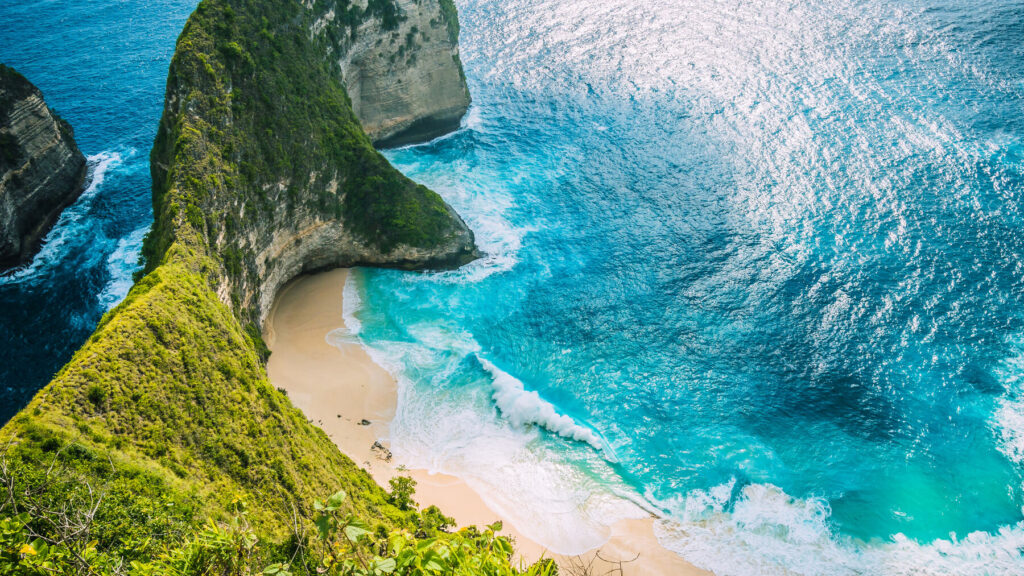
- Kelingking Beach - The T-Rex shaped cliff peninsula with a hidden white sand beach below is the signature shot of Nusa Penida. Free to view from the top. The hike down to the beach and back takes 2–3 hours and is steep not suitable for those with knee issues or during wet season when paths are slippery.
- Broken Beach and Angel's Billabong - A natural rock arch forming a lagoon (Broken Beach) and a natural infinity pool in the rock platform (Angel's Billabong). Both are free to visit and located within 5 minutes of each other. Best visited in the morning when tide and light are at their best.
- Crystal Bay snorkelling - One of the best snorkelling spots in the Bali region, with manta rays frequently spotted in the bay. Snorkelling gear can be hired on the beach for approximately ₹300–400. Manta sightings are most common between June and October.
A full-day Nusa Penida West Tour (fast boat + island car + guide + snorkelling) costs ₹3,500–5,000 per person when booked through TripToOcean. We offer this as an add-on in many of our Bali trip packages. Book a day in advance because fast boats sell out on peak days.
6. Nusa Lembongan & Nusa Ceningan - Relaxed Island Escape
If Nusa Penida is raw and dramatic, its smaller neighbour Nusa Lembongan is relaxed and polished. The island sits a 30-minute fast boat ride from Sanur and is small enough to explore entirely by scooter in an afternoon. There are no traffic jams, no loud clubs, just white sand, clear water, good snorkelling, and some of the most beautiful ocean views on the Bali circuit.
The highlight is the Blue Lagoon viewpoint on Nusa Ceningan, accessible via a narrow suspension bridge from Lembongan. The turquoise colour of the water here is extraordinary especially at high tide on a clear morning. Many couples and families include a 1-night Nusa Lembongan stay in their Bali Indonesia tour packages for a genuine change of pace from the mainland.
7. North & East Bali - Waterfalls, Volcanoes & Quiet Temples
North and East Bali are often skipped by first-time visitors - which is exactly what makes them rewarding. The landscape is greener, quieter, and noticeably less commercial than the south. The pace of life is different. And several of Bali's most beautiful natural and spiritual sites sit here, away from the tourist crowds of Ubud and Seminyak.
Top things to do in North & East Bali:
- Sekumpul Waterfall - Widely regarded as the most beautiful waterfall in Bali - a cluster of 7 falls in a lush green gorge. Entry and guide fee combined: approximately ₹400–600. The hike in takes 30–45 minutes through rice fields and jungle. Best visited in the morning (8–11am) before afternoon clouds roll in.
- Pura Ulun Danu Beratan - An 17th-century water temple sitting partially over a volcanic lake in the mountains near Bedugul. Entry: approximately ₹200. This is one of Bali's most photographed temples and is at its most beautiful in the early morning when mist hangs over the lake.
- Pura Lempuyang (Gates of Heaven) - The iconic split gate shot with Mount Agung reflected in a pool of water below. Entry is free but the reflection shot is usually created with a mirror held by the temple photographer - it costs approximately ₹300–500 for a few shots. Arrive by 7am to avoid queues of 45–90 minutes that build up by mid-morning.
- Mount Batur sunrise trek - A 2-hour predawn hike to the rim of an active volcano for sunrise above the clouds. Guide fee: ₹1,500–2,000 per person (mandatory - guides are required for this trek). The view of the sunrise over the lake and Mount Agung in the distance is worth the 3am wake-up call.
Best Time to Visit Bali in 2026 - Month by Month Guide
Bali has two seasons: a dry season (roughly April–October) and a wet season (roughly November–March). The temperature stays comfortably between 24–33°C year-round - there is no "cold" month in Bali. The difference is rainfall, humidity, crowd levels, and pricing.
Month-by-Month Breakdown
January–February: Peak wet season. Afternoon rain showers are common, though mornings are often clear. Crowds are much lower, and hotel prices are at their annual lowest - pool villas that cost ₹12,000/night in July can often be found for ₹5,000–6,000. If your itinerary is indoor-friendly (cultural tours, cooking classes, temple visits, spa days), these months can offer exceptional value for Indian families and honeymooners on a tighter budget.
March: The tail end of the wet season. Rain becomes less frequent and showers shorter. Nyepi (Balinese New Year / Day of Silence) falls in March 2026 - the entire island goes completely quiet for 24 hours with no flights, traffic, or noise. It is a deeply unusual experience to witness but requires planning as the airport closes and all activity stops for the day.
April–May: One of the two best times to visit Bali. The rains have largely cleared, the landscape is lush and green from the wet season, humidity drops, and prices are mid-range before the European summer peak. Ocean conditions are excellent for snorkelling and swimming at Nusa Penida. Most TripToOcean clients who travel in April–May report clear skies for 90% of their trip. Highly recommended for Indian travellers booking around school holidays.
June–August: Peak tourist season. The driest and sunniest months - perfect weather, calm oceans, and optimal snorkelling conditions (manta ray sightings at Crystal Bay are most reliable June–October). The downside: this is also the most crowded and most expensive period. Bali receives its highest volume of Australian, European, and Japanese tourists in July–August. Book hotels and activities at least 60–90 days in advance. Uluwatu Kecak show tickets can sell out. Prices are 30–50% higher than shoulder season.
September–October: The second-best window - and often preferred by experienced Bali travellers. Weather is still reliably dry and sunny. Crowds have thinned from the August peak. Hotel prices drop back to mid-range. The landscape remains lush. Snorkelling is still excellent. October is particularly pleasant - warm, clear, and far less congested than July. Indian travellers booking around Diwali holidays in October often find this the ideal timing.
November–December: The wet season begins to return, though rain is usually limited to 1–2 hour afternoon showers rather than all-day downpours. The Christmas–New Year period (December 20 – January 5) is a notable exception - it sees a spike in visitors and prices comparable to July–August. If visiting in December, either book well in advance for peak period or plan your trip for early December before the holiday surge.
Summary for Indian travellers: April–May and September-October offer the best combination of weather, crowd levels, and value. For budget travellers, January–February with the right itinerary can be excellent. Avoid the Christmas–New Year week unless you book 3–4 months ahead.
How Much Does a Bali Trip Cost from India? (2026 Estimates)
One of the most searched questions by Indian travellers is what Bali actually costs. Here is an honest, up-to-date breakdown for 2026 so you can plan your budget before choosing a package.
Entry costs (one-time, per person):
- Visa on Arrival (e-VOA): IDR 500,000 ≈ ₹2,700 per person (30-day single entry). Apply online at molina.imigrasi.go.id before flying to skip the airport queue.
- Bali Tourist Levy: IDR 150,000 ≈ ₹800 per person. Pay online via the Love Bali portal before departure and keep the QR code on your phone.
Typical activity costs (per person):
- Uluwatu Temple entry: ₹250–300 | Kecak Dance show: ₹350–400
- Tegallalang Rice Terraces: free (small donation of ₹50–100 appreciated)
- Sacred Monkey Forest: ₹350
- Nusa Penida full-day tour (boat + car + guide): ₹3,500–5,000
- Mount Batur sunrise trek with guide: ₹1,500–2,000
- Waterbom Bali (water park): ₹2,800–3,500
- Pura Lempuyang (Gates of Heaven): free (photo with reflection: ₹300–500)
- Sekumpul Waterfall: ₹400–600 (entry + guide)
- Tanah Lot Temple: ₹350–400
Currency tip: INR is not accepted in Bali - you will need Indonesian Rupiah (IDR). The exchange rate in 2026 is approximately 1 INR = 190–195 IDR. The most cost-efficient method is a Zero Forex markup card (such as Niyo Global, Scapia, or Fi) used at Bali ATMs - this gives you close to the interbank rate with no conversion fee. Avoid exchanging at the airport or at small street-side money changers.
Overall, a 6-day couple's Bali trip including mid-range hotel, activities, food, and local transport typically costs ₹80,000–1,50,000 for two (excluding flights). TripToOcean's packaged options start from ₹29,999 per person and bundle all the logistics so you don't have to plan each element separately.
People Also Ask
The best things to do in Bali for couples include watching the sunset at Uluwatu Temple with the Kecak dance show, exploring Ubud rice terraces and Monkey Forest, taking a Nusa Penida day trip, enjoying beach clubs in Seminyak, and a romantic candlelight dinner by the ocean. TripToOcean's Bali honeymoon packages include all these experiences starting from ₹29,999/person.
6 days is the ideal duration for a Bali trip, covering the main regions: Ubud (culture), Uluwatu (temples & sunset), Nusa Penida (adventure), Seminyak or Canggu (beaches & nightlife), and Kuta (shopping & surfing). TripToOcean offers customizable 6-day Bali packages for all budgets.
The best time to visit Bali is during the dry season from April to October. This period offers sunny weather ideal for beaches, temple visits, and outdoor sightseeing. The wet season (November to March) has fewer crowds and better deals on Bali tour packages.
Bali tour packages from India start from ₹29,999 per person for a 6-day trip with TripToOcean, including hotel stays, airport transfers, Uluwatu Temple sunset tour, Nusa Penida day trip, and Ubud sightseeing. Honeymoon packages with luxury resorts are available from ₹51,999 per person.