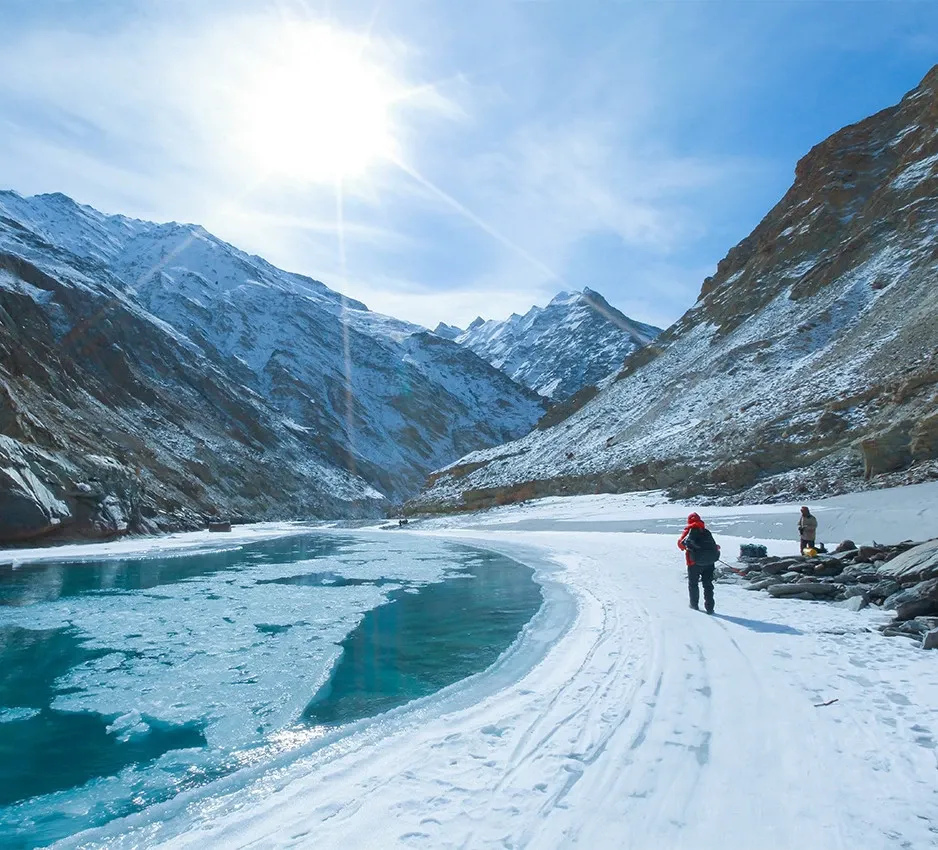

The Chadar Trek is unlike anything else you will do in India. Every January and February, the Zanskar River in Ladakh freezes solid and for a narrow window of six to eight weeks, it becomes a trail. Locals have used this frozen highway for centuries to cross the otherwise impassable Zanskar Gorge in winter. Today, trekkers from across the country and world come to walk it too. Not because it is comfortable. Because there is nothing else like it.
Chadar means sheet or blanket in Hindi, which is exactly what the frozen river looks like from the cliffs above a long, pale ribbon of ice stretched between vertical walls of rock. The trail itself sits at around 11,000 feet, so altitude is less of a concern than on most Himalayan treks. The real challenge here is cold. Temperatures drop to -15°C to -25°C at night, and wind off the gorge cuts through everything. The ice surface shifts constantly - cracking, flooding, refreezing - which means no two days on the Chadar look the same.
This is an 8-day trek from Leh. You spend two days acclimatising, completing a fitness check, and gathering permits, then drive to the trailhead at Shingra Koma and walk into the gorge. The route goes in to the Nerak Frozen Waterfall, one of the more extraordinary things you can see in India in winter and then turns back. Total walking distance is roughly 64 km. Most trekkers camp in caves carved into the cliff face. Some nights you sleep with a wall of ice behind you and the frozen river three metres below.
TriptoOcean runs the Chadar Trek with licensed Ladakhi guides who know the river's condition year to year, a full kitchen crew, and a medical kit carried on trail. All permits are sorted before you arrive in Leh. All meals are covered from Day 1 dinner to Day 8 breakfast. If you have been thinking about doing this trek, 2026 is the time the season only runs for about six weeks and batches fill quickly.
A TripToOcean representative meets you at Kushok Bakula Rimpochee Airport, Leh and transfers you to your guesthouse. The rest of Day 1 is strictly for rest and acclimatisation - Leh sits at 11,500 feet and your body needs time to catch up. Headaches and mild breathlessness are normal in the first 24 hours. Drink water, eat light, and sleep early.
If you feel well enough by evening, a short walk through the Leh market is fine. Do not push it. Altitude sickness does not care how fit you are, and the most common mistake trekkers make is overexerting on Day 1.
Overnight: Leh guesthouse | Meals: Breakfast + Dinner
A second acclimatisation day before any strenuous activity. The guide team will check your oxygen saturation and general health. You can visit Leh Palace, Shanti Stupa, or nearby monasteries like Hemis and Thiksey at a gentle pace — these are at roughly the same altitude as Leh, so they serve as useful acclimatisation walks without added risk.
In the evening, TripToOcean holds a detailed pre-trek briefing covering the route, ice safety protocols, altitude awareness on the frozen river, campsite arrangements, and cold-weather gear checks. All permits are handed out during this session. Gear rental for sleeping bags and crampons (if needed) is arranged from Leh.
Overnight: Leh guesthouse | Meals: Breakfast + Dinner
Early morning drive from Leh to Shingra Koma - about 73 km, taking 5–6 hours on mountain roads through Nimmu and along the Zanskar River valley. The road itself gives you the first proper view of the gorge in winter, and the shift in landscape from Leh's relative openness to the tight, icy canyon of the Zanskar is immediate.
At Shingra Koma, you step onto the frozen river for the first time. The first 2.5-3 km to Tsomo Paldar is intentionally short - it lets you get used to walking on ice, reading the surface, and understanding how the frozen river behaves before committing to longer days. You will camp here tonight, typically in a cave shelter or tent depending on conditions.
Overnight: Cave camp / tent at Tsomo Paldar | Meals: Breakfast + Lunch + Dinner | Trek: ~2.5-3 km, 2 hrs
The first full day on the Chadar. The route follows the frozen river through a series of bends, narrow gorge sections, and open flats where the ice is at its most stable. You will learn quickly that the Chadar is never uniform - sections of solid blue ice give way to patches of fragile surface where the river has partially thawed and refrozen. Your guide reads these constantly.
Along this stretch you will see frozen waterfalls clinging to cliff faces, their water stopped mid-fall in winter. The walls of the gorge rise 300–400 metres on both sides. The scale is difficult to convey in photographs. Reach Tibb Cave by late afternoon - this is one of the most famous stops on the Chadar, a natural cave shelter used by Zanskari traders for generations. The cave sleeps 20–25 trekkers.
Overnight: Tibb Cave | Meals: Breakfast + Lunch + Dinner | Trek: ~13-15 km, 6–7 hrs
The highlight of the entire trek. The route from Tibb to Nerak passes through some of the most dramatic sections of the Zanskar Gorge and ends at the Nerak Frozen Waterfall — a multi-tiered cascade of ice, blue-white and enormous, locked in place against a sheer cliff. It is one of those sights that stops people mid-step. Spend as long as you need here before continuing to Nerak camp.
Nerak Village itself is one of the most remote permanently inhabited places in India. In winter, the only way in or out is the Chadar. The dozen or so families who live here spend the cold months almost entirely cut off from the rest of Ladakh. The village sits at the confluence of a side valley and the Zanskar, and the camp here has a different quality to it — quieter, starrier, further from everything.
Overnight: Nerak Camp (cave or tent) | Meals: Breakfast + Lunch + Dinner | Trek: ~12 km, 5–6 hrs
The return journey begins. The walk back through the Zanskar Gorge looks different heading south — the light hits the ice differently in the afternoon, and you pick up details you missed coming in. The ice surface itself may have changed overnight: a section that was solid the day before can soften, and sections you bypassed on the way in might now be crossable.
Your guide makes the call on the exact path throughout. Back at Tibb Cave for the second night, legs are tired but the body is warm from a full day of movement. The temperature here drops fast after sunset.
Overnight: Tibb Cave | Meals: Breakfast + Lunch + Dinner | Trek: ~12–14 km, 5–6 hrs
The final stretch on the river. The 15–17 km walk back to Shingra Koma is the longest day of the return leg. Most trekkers find it passes quickly — the body is adapted to the cold by now, the pace feels comfortable, and the trailhead marks the end of the ice. Reaching Shingra Koma and stepping off the river is a small moment, but it stays with people.
Transport waits at the trailhead. The drive back to Leh takes 5–6 hours. You arrive in the evening — hot water, a proper meal, and a warm room are waiting. The guide team will hold a short wrap-up and hand out any certificates.
Overnight: Leh guesthouse | Meals: Breakfast + Dinner
Breakfast at the guesthouse. Depending on your flight time, use the morning for any last shopping in Leh's main market — Pashmina products, Ladakhi dry apricots, thangka paintings, and prayer flags are the most popular picks. Your TripToOcean representative will transfer you to the airport in time for your departure.
Meals: Breakfast
Cancellation (from date of written notice received by TripToOcean):
30+ days before departure: 10% deduction (admin + processing charges); 90% refunded as Trek Credit valid 12 months
15–29 days before departure: 30% deduction; 70% Trek Credit valid 12 months
7–14 days before departure: 50% deduction; 50% Trek Credit valid 12 months
1–6 days before departure: 100% forfeiture — all arrangements are in place
No-show / after departure date: No refund applicable
Trek cancellation by TripToOcean (weather, river conditions, force majeure):
Full refund or free rescheduling to the next available batch — your choice
If the Chadar does not form adequately in a given year, full refunds are processed within 7–10 working days
Rescheduling (within the same season):
15+ days before departure: ₹2,000 rescheduling fee per person
7–15 days before departure: ₹4,000 rescheduling fee per person
Within 7 days: Treated as cancellation — new booking required
50% of the total package cost at the time of booking confirmation to secure your batch seat
50% balance due 21 days before departure — or on arrival in Leh as agreed with TripToOcean
Bookings within 7 days of departure require full payment upfront
Payment accepted via UPI, bank transfer, or card through the TripToOcean platform
GST (5%) is payable separately on the total package cost
By Air: The only practical option in winter. Kushok Bakula Rimpochee Airport (IXL), Leh, has direct flights from Delhi (1 hr 20 min), Mumbai, Chandigarh, and Srinagar. IndiGo, Air India, and Go First operate regular services. Book early -January-February flights to Leh sell out as the Chadar season approaches. TripToOcean arranges airport pickup for all confirmed trekkers.
By Road: Not possible in winter. Both the Manali-Leh Highway and the Srinagar-Leh Highway are closed from November to May due to snow. The only way into Leh in January-February is by air.
Arriving Early: We strongly recommend arriving in Leh at least one full day before your trek departs - ideally two days if you are flying from a low-altitude city. The acclimatisation days built into the itinerary help, but arriving the previous evening gives your body extra time to settle. Altitude sickness is not predictable, and rushing into a trek without adequate rest is the most avoidable risk on the Chadar.
Documents for Indian Nationals: A valid Passport or Voter ID Card is sufficient for Ladakh. Aadhaar Card alone is not accepted as a travel document for flights within India if used in combination with Ladakh-specific entry permits (though it works for domestic airline ID checks). Carry your Aadhaar or PAN for reference but travel with Passport or Voter ID. TripToOcean handles all Inner Line Permit (ILP) processing on your behalf - you do not need to apply separately.
You carry a day pack (5–8 kg) on the ice. Porters carry the main duffel. Pack heavy items in the porter bag — take only what you need for the day in your backpack.
Thermal base layers (top + bottom) × 3
Fleece mid-layer jacket
Down jacket (-20°C rated)
Waterproof outer shell (jacket + pants)
Warm balaclava × 2
Liner gloves + outer insulated gloves
Woollen socks × 5–6 pairs
Neck gaiter / buff
Waterproof insulated trekking boots
Gaiters (essential for ice and snow sections)
Crampons or micro-spikes (rental available in Leh)
Camp sandals or thermals for cave nights
Trekking poles (adjustable — for balance on ice)
Sleeping bag (-20°C rated) — rental in Leh
Day pack 25–30L (waterproof cover)
Main duffel bag 60–70L (for porter)
Headlamp + spare batteries
High-capacity power bank
UV sunglasses (glacier rated)
SPF 50+ sunscreen + lip balm
Insulated water bottles × 2 (1L each)
Pulse oximeter (self-monitoring)
First aid: blister pads, ibuprofen, antiseptic
Hand warmers (chemical packets)
Personal prescriptions + extras
Passport / Voter ID (original)
Insurance documents (digital + physical)
INR cash in small denominations (₹500 and below)
ATMs only in Leh — carry sufficient cash before trailhead
Full rental gear list available in Leh near Main Bazaar. TripToOcean provides a specific gear checklist after booking confirmation.
Included in Your Package:
All meals from Day 1 dinner to Day 8 breakfast (breakfast + lunch + dinner daily on trail)
Guesthouse accommodation in Leh (Day 1, 2, 7 nights)
Cave or tent camping on the trail (Days 3–6)
Government-licensed, English-speaking Ladakhi trek guide
Cook + kitchen support crew on trail
Government-registered porter (1 per 2 trekkers)
All porter, guide, and crew expenses — meals, wages, and transport
Inner Line Permit (ILP) for Chadar Trek
Wildlife Protection Entry Fee
Leh airport pickup and drop
Shingra Koma trailhead transfer (shared vehicle)
Medical kit carried on trail throughout
Daily oxygen saturation checks from Day 3 onwards
Trek completion certificate from TripToOcean
Not Included:
Airfare to/from Leh (any city)
Hotel accommodation beyond the nights listed above
Travel insurance covering emergency evacuation (mandatory — see Safety section)
Personal trekking clothing and gear
Sleeping bag rental if required (available in Leh, approx. ₹400–600/day)
Crampons or trekking pole rental (available in Leh, approx. ₹200–400/day)
Personal expenses — drinks, snacks beyond meals, phone charging, laundry
Costs due to weather delays, route changes, or force majeure events
Any services not listed above
GST (5%) on package cost
Most treks follow mountain trails. The Chadar Trek follows a frozen river. The terrain, the risk profile, and the experience are entirely different from any summer or autumn Himalayan trek. There are no marked paths on ice - the river's surface constantly changes, and your guide reads the conditions in real time. The altitude is comparatively low (below 12,000 ft), so acute mountain sickness is less of a concern than on EBC or high-pass treks, but the cold is far more extreme. It is the only winter river trek of this kind in India.
Not recommended for complete beginners. The Chadar is not technically difficult, but it requires physical fitness and some comfort with sustained outdoor exposure in extreme cold. If you have done a multi-day trek before - even a relatively easy one - you have the basic preparation framework. If you have never trekked at all, the Chadar is a poor first choice. The risks from cold, slippery surfaces, and the remote location are more manageable for someone who knows how their body behaves under sustained outdoor effort.
This does happen - not often, but it has happened. The Chadar's formation depends on sustained sub-zero temperatures across December and early January. In years with a warm December, the ice forms late and the first batches may be cancelled or delayed. TripToOcean monitors conditions from Leh-based contacts and communicates directly with all confirmed trekkers as conditions develop. If your batch cannot operate, you get a full refund or free transfer to the next available batch. We do not proceed with a trek when conditions are genuinely unsafe.
Budget ₹40,000–₹50,000 per person all-in from Delhi for the shared group option. This breaks down roughly as: ₹24,499 TripToOcean package + ₹1,225 GST (5%) + ₹14,000–₹18,000 for return flights Delhi–Leh–Delhi (book early, January prices spike). Add ₹2,000–₹3,000 for any gear rental in Leh and ₹1,000–₹2,000 for personal spending. The private and small-group tiers cost more on the land package side; flights stay the same regardless of package tier.
Yes. Two permits are required: the Inner Line Permit (ILP) for restricted areas of Ladakh, and the Wildlife Protection Entry Fee for the Zanskar region. Both are included in the TripToOcean package price - you do not need to apply separately. TripToOcean handles the paperwork on your behalf using copies of your ID documents, which you will submit at the time of booking. Foreign nationals require an additional permit and should enquire separately.
Yes, and many experienced trekkers prefer early February over January. By February, the ice tends to be more stable and consolidated, the days are slightly longer, and the season is well-established. The trade-off is that late February can see the river begin to soften as temperatures start edging up - which is why our last batch departs in the second week of February. The ideal window, year on year, is the last week of January to the first week of February.