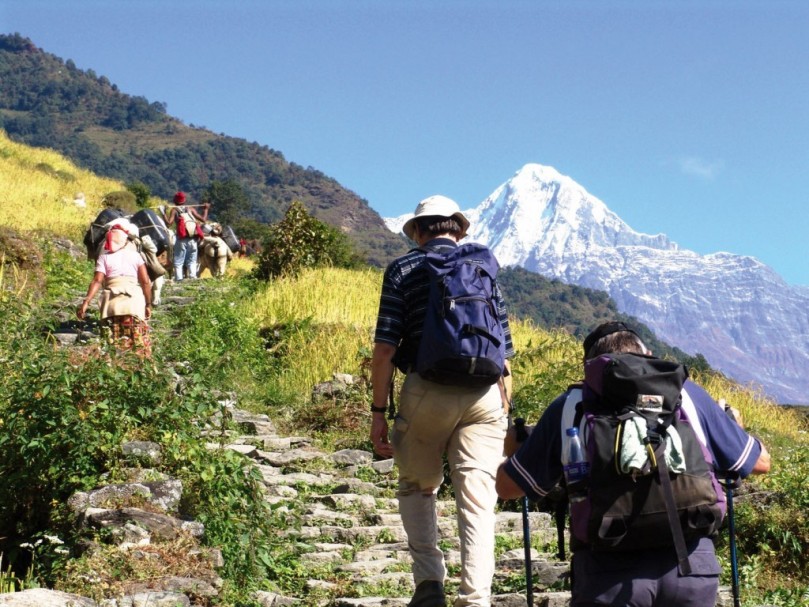

There's a reason Ghandruk appears on almost every list of Nepal's best short treks. It's not just the views, although those are extraordinary. It's not just the rhododendron forests ablaze in spring colour, or the silence of stone paths in the early morning mist, or the sight of Machhapuchhre appearing suddenly above a ridgeline as you round a corner. What makes Ghandruk special is the feeling that you've stepped into Nepal as it has existed for centuries - a living, breathing Gurung village where traditions are still practised, old soldier's stories echo through the teahouses, and the mountain backdrop is simply part of daily life.
The Ghandruk Trek from Kathmandu is one of the most complete Nepal experiences a traveller can have in 8 days. It begins in the ancient capital, where UNESCO World Heritage Sites line your first two days - Pashupatinath, Boudhanath, Swayambhunath, and Kathmandu Durbar Square introducing you to Nepal's extraordinary historical layers. Then comes the scenic overland journey to Pokhara, Nepal's outdoor adventure capital, where Phewa Lake, Sarangkot, the World Peace Pagoda, and the International Mountain Museum offer a full day of discovery. From Pokhara, the journey climbs into the Annapurna hills toward Ghandruk - and here is where the trek becomes something genuinely memorable.
Ghandruk sits in the Kaski district within the Annapurna Rural Municipality, roughly 32 km northeast of Pokhara and at an altitude of 2,012 metres. It is the largest and most developed Gurung village in the entire Annapurna region and it wears that distinction quietly. The village is famous for its traditional stone architecture, its honey-hunting heritage, and its deep connection to the Gurkha military tradition. Many of the older residents have served with the British or Indian Army, and their stories are freely shared over dal bhat in the evenings if you take the time to ask. The Gurung Museum at the village centre documents this history beautifully - weapons, photographs, costumes, and oral accounts of a culture that has remained remarkably intact despite the passage of time.
The trek to Ghandruk from Pokhara passes through terraced rice fields, rhododendron and oak forests, and a series of charming smaller villages. The trail is well-marked, the gradient is gentle by Himalayan standards, and there is zero risk of altitude sickness at this elevation, making it completely accessible to beginners, senior trekkers, and family groups. Along the way, the mountains reveal themselves slowly: first as pale shapes behind forest ridgelines, then as full, overwhelming presences - Annapurna South (7,219 m), Hiunchuli (6,441 m), Machhapuchhre (6,993 m), Gangapurna (7,455 m) - all visible from the village on a clear day in a way that still surprises people who thought they knew what Himalayan views looked like.
This is not a trek that pushes you to your physical limits. It is a trek that shows you exactly what Nepal is, and why people keep returning.
Your journey begins at Tribhuvan International Airport, Kathmandu, where a TriptoOcean representative meets you on arrival and guides you through the initial welcome of Nepal's busy, charismatic capital. Transfer to your hotel, a journey of around 25 minutes from the airport. The rest of the day is yours to settle in, recover from travel, and take your first steps into Kathmandu. The neighbourhood of Thamel, a short walk from most tourist hotels, is a wonderful introduction - lantern-lit lanes, mountain equipment shops, excellent cafes, and the smell of incense and street food mixing in the evening air. Rest well. The exploration starts tomorrow.
Overnight: Hotel in Kathmandu
After breakfast, a full-day cultural immersion through some of Asia's most extraordinary heritage sites:
Pashupatinath Temple - One of the holiest Hindu temples in the world, dedicated to Lord Shiva, set dramatically on the banks of the Bagmati River. The riverside ghats offer a rare and moving window into Nepal's spiritual life.
Boudhanath Stupa - One of the largest Buddhist stupas in the world, and a meditative, magnificent place to walk, observe, and absorb. The stupa's watchful painted eyes are iconic; the butter-lamp light at dusk here is unforgettable.
Swayambhunath (Monkey Temple) - Perched on a hill above the Kathmandu Valley, this ancient stupa rewards the climb with panoramic views of the city, the surrounding hills, and, on clear days, the distant Himalayan skyline.
Kathmandu Durbar Square - The historic royal palace complex at the heart of the old city, where Newari architecture, carved wooden temples, courtyards, and living goddesses coexist in a space that feels genuinely ancient.
Overnight: Hotel in Kathmandu
An early breakfast, then your guide collects you from the hotel for the overland journey to Pokhara. The drive westward from Kathmandu follows the Prithvi Highway along river valleys - the Trishuli and Marsyangdi - through a Nepal that most short-stay visitors never see. Terraced fields cascade down hillsides. Traditional villages appear around corners. The landscape grows more mountainous as Pokhara approaches, and if the weather cooperates, the first Himalayan giants begin to appear above the horizon. Upon reaching Pokhara, relax along Phewa Lake - Nepal's second-largest lake and one of its most serene places or simply rest and prepare for the sightseeing day ahead.
Overnight: Hotel in Pokhara
Pokhara is Nepal's outdoor capital and one of the most beautiful cities in the Himalayas. Today you explore it properly:
Sarangkot - A hilltop viewpoint above Pokhara famous for its sunrise panorama over the Annapurna and Dhaulagiri ranges. The sight of Machhapuchhre glowing in the first light of morning is one of Nepal's defining visual experiences.
Phewa Lake & Boating - A peaceful, drifting hour on Pokhara's mirror-flat lake, with the mountains reflected on the water and the Barahi Temple sitting on a small island in the middle.
World Peace Pagoda - A gleaming white Buddhist stupa on a ridge above the southern shore of Phewa Lake, offering panoramic views of the lake, city, and Annapurna range that are among the finest in the region.
International Mountain Museum - A world-class museum dedicated to the Himalayan peaks, the mountaineers who climbed them, and the indigenous communities who call them home. Highly recommended for anyone interested in the deeper story of Nepal's mountains.
Overnight: Hotel in Pokhara
An early departure from Pokhara toward the Annapurna hills. The drive heads northeast through increasingly dramatic mountain landscapes, passing through Nayapul and up toward Kimche, one of the common starting points for the Ghandruk trail. The trail from here to Ghandruk is a wonderful introduction to Himalayan trekking: stone-paved paths, suspension bridges draped with prayer flags, river crossings, terraced farmlands climbing in neat steps up the hillsides, and the gradual but unmistakable appearance of the mountains ahead.
Upon reaching Ghandruk village (2,012 m), the scale of what surrounds you becomes clear. The village occupies a natural amphitheatre in the Annapurna hills, and the mountain views here - Annapurna South, Hiunchuli, Machhapuchhre are uninterrupted and genuinely jaw-dropping. Spend your first evening walking the stone lanes, watching locals go about their day, and waiting for the moment the last light catches the peaks in shades of orange and red.
Overnight: Teahouse / Guesthouse in Ghandruk
A full day to go deeper into Ghandruk and there is more here than first appears. Highlights of the day:
Gurung Museum - A beautifully maintained cultural repository documenting Gurung history, Gurkha military heritage, traditional dress, weapons, and oral traditions. A genuine education, and one of the best village museums in Nepal.
Annapurna Conservation Area Project (ACAP) Headquarters - Located in the village, ACAP manages the largest protected area in Nepal over 1,000 flowering plant species, snow leopards, red pandas, and more than 400 bird species all fall within its bounds.
Village Exploration & Viewpoint Hikes - Walk the cobblestone lanes, photograph the traditional slate-roofed stone houses, chat with Gurung families on their doorsteps, and take one of the short trails to the hilltop viewpoints that frame the Annapurna massif in all directions.
Cultural Evening - Depending on timing and local events, this day often includes opportunities to witness or participate in traditional Gurung dance and music, taste local cuisine including Gurung-style dal bhat, and experience the genuinely open hospitality that defines this community.
Overnight: Teahouse / Guesthouse in Ghandruk
An early morning farewell to Ghandruk - and the mountains. After breakfast, the journey back begins: down from the village to the trailhead, then by road through Pokhara and onward to Kathmandu. The drive is long (around 7-8 hours total), but the scenery keeps changing and the return journey always carries a pleasant reflective quality - you've seen the country from the mountains looking out, and now you're descending back into the valley. There's time in Kathmandu's Thamel area in the evening for last-minute souvenir shopping, handicraft purchases, or simply a quiet final dinner in Nepal.
Overnight: Hotel in Kathmandu
After breakfast, a TriptoOcean representative transfers you to Tribhuvan International Airport for your departure flight. Your 8-day Ghandruk journey - Kathmandu's ancient temples, Pokhara's mountain lakes, and the stone-paved lanes of a Gurung village in the Annapurna hills - comes to a close.
Clothing: Sturdy hiking boots with ankle support, moisture-wicking base layers, quick-dry trekking pants, fleece or insulated mid-layer, waterproof and windproof outer jacket and pants, warm hat, gloves, and neck buff.
Equipment: 30-40 litre daypack, sleeping bag (sub-zero rated recommended for winter visits), trekking poles, headlamp with spare batteries, 2-litre water capacity (bottle or hydration bladder), sunglasses, high-SPF sunscreen, and a basic first aid kit including blister treatment and any personal medications.
Miscellaneous: Trekking map, energy snacks and bars, sufficient Nepali Rupees cash (ATMs are limited or unavailable in trekking areas), toiletries including toilet paper, hand sanitiser and wet wipes, camera and power bank, and a reusable water bottle with purification tablets.
Arrival Point: Tribhuvan International Airport, Kathmandu, Nepal - your TriptoOcean representative meets you on arrival.
From India by Air: Direct flights to Kathmandu operate from Delhi, Mumbai, Kolkata, Bengaluru, Chennai, Varanasi, and several other Indian cities. Flight time from Delhi is approximately 1.5 hours. Book round-trip flights to Kathmandu (KTM).
Nepal Visa: Indian nationals do not require a visa to enter Nepal. All other nationalities can obtain a visa on arrival at Tribhuvan International Airport - USD 30 for 15 days, USD 50 for 30 days. Bring passport-size photographs and USD cash for the visa fee.
From Kathmandu to Pokhara: Your itinerary includes an overland tourist bus transfer on Day 3 (approx. 200 km, 6-7 hours). Private vehicle or flight upgrades can be arranged at extra cost on request.
From Pokhara to Ghandruk Trek Start: Approximately 1-2 hours by road to Nayapul or Kimche, followed by a 4-6 hour guided trek to Ghandruk village. All trailhead transport is included.
Spring (March-May) ★★★★★ - The finest season for the Ghandruk Trek. Rhododendron forests burst into bloom in rich reds and pinks, creating one of Nepal's most photographed natural spectacles. Skies are generally clear, temperatures are comfortable, and the mountains are sharply visible. Peak trekking season.
Autumn (September-November) ★★★★★ - Equally outstanding. Post-monsoon skies are the clearest of the year, mountain views are at their sharpest, temperatures are stable and pleasant, and the festive period of Dashain and Tihar adds a cultural dimension to the journey. The other peak trekking season.
Winter (December-February) ★★★☆☆ - Cold but manageable. The trails are quieter, the air is crisp, and snowfall at Ghandruk's altitude (2,012 m) is light and rare. Good for those who prefer solitude over crowds, but pack warm layers.
Monsoon (June-August) ★★☆☆☆ - Rain is heavy, trails become slippery and leech-prone, and mountain views are often obscured by cloud. Not recommended for first-time trekkers, though experienced trekkers who love lush green landscapes and empty trails sometimes choose this season deliberately.
Yes, completely.
The Ghandruk Trek is widely regarded as one of the most beginner-friendly treks in the entire Himalayan region. The maximum altitude is just 2,012 metres - well below the threshold for altitude sickness. The daily trekking distance is moderate, the trails are well-marked and well-maintained, and teahouses provide warm meals and comfortable beds along the route. If you can manage a brisk 4-6 hour walk on uneven terrain, you can complete this trek comfortably.
The risk is virtually zero. At a maximum elevation of 2,012 metres, Ghandruk sits well below the 3,000-metre threshold where altitude sickness typically begins. This is one of the main reasons the trek is recommended for families, senior travellers, and anyone who wants a Himalayan experience without the medical concerns of higher-altitude routes like Annapurna Base Camp or Everest Base Camp.
Two permits are required: the Annapurna Conservation Area Permit (ACAP) and the Trekkers Information Management System (TIMS) card. Both are included in the TriptoOcean package price. You don't need to arrange these yourself - your guide team handles everything.
Yes. The Ghandruk Trek is one of the few Himalayan treks genuinely suitable for children. The moderate trail, low altitude, and availability of teahouse accommodation makes it a viable family adventure. Porters can help carry children's backpacks, and the pace is fully adjustable to group needs.
During the trekking days (Days 5 and 6), you stay in well-established teahouses and guesthouses in Ghandruk village. These range from basic but comfortable twin-sharing rooms to modest lodges with attached bathrooms. Warm blankets, basic meals, and a genuinely welcoming atmosphere are standard. In Kathmandu and Pokhara, accommodation is in tourist-class hotels.
No prior trekking experience is required. The trail to Ghandruk involves stone-paved paths, some steep stone stairways, and a few river crossings - all manageable with reasonable fitness and a comfortable pair of trekking boots. A basic habit of walking regularly is sufficient preparation for most people.
As of 2025, Nepal's trekking regulations require a licensed guide for all trekking routes. This package includes a government-licensed, English-speaking trek leader - a requirement that also genuinely enhances your experience, as a good guide brings cultural insight, logistical ease, and safety assurance that solo navigation simply cannot match.
Autumn (October-November) consistently offers the best mountain visibility - post-monsoon skies are the clearest of the year, and the views of Annapurna South, Machhapuchhre, and Hiunchuli from Ghandruk at this time are as close to perfect as mountain photography gets. Spring (March-May) is an equally strong alternative, particularly if you want to see the rhododendron forests in bloom.
The trek is technically possible throughout the year. However, the monsoon months of June to August bring heavy rainfall, slippery trails, and poor visibility, and are not recommended for beginners or families. The shoulder months of March-May and October-November offer the ideal combination of weather, visibility, and trail conditions.
Carry sufficient Nepali Rupees (NPR) in cash before leaving Pokhara. ATMs are either unavailable or unreliable in trekking areas, and most teahouses only accept local currency. Exchange money or withdraw cash in Kathmandu or Pokhara before heading into the mountains. Keep a daily budget of NPR 1,500–3,000 for personal expenses including hot drinks, snacks, Wi-Fi, and hot showers.