
10 Best Camping Destinations in India 2026 - A Real Traveler's Guide

Priya Sharma
Travel Writer & Adventure Enthusiast
India doesn't do anything at half-pace, and camping here is no exception. In a single country you can wake up to the sound of the Ganga rushing past your tent, fall asleep under the stars in the Thar Desert, or open your tent zip to a 4,000-meter Himalayan lake that looks like it was designed for a film set. The geography is genuinely ridiculous.
Camping as a travel style has grown a lot in India over the last few years - partly because organized campsites have gotten much better, partly because people are tired of cookie-cutter hotel rooms. Whatever the reason, more and more travelers are choosing a night in a tent over a night in a room, and most of them don't regret it.
This guide covers the 10 best camping destinations in India, with practical information on what each spot is actually like, when to go, what kind of camper it suits, the rules and permits you'll need, and what to expect once you're there.
Before You Go - Permits, Rules & Government Guidelines
This is the section most camping blogs skip. Don't skip it.
Camping in India is governed by different rules depending on where you camp. Here's what you need to know before booking anything:
Inside National Parks and Wildlife Sanctuaries: Independent camping is not permitted. You must stay at authorized government or operator-run campsites and carry a valid permit issued by the State Forest Department. Most reputable tour operators handle this for you. Carry a government-issued photo ID at all times (Aadhaar, Driving Licence, Passport, Voter ID).
High-altitude and restricted areas: Regions like Spiti Valley, Tso Moriri (Ladakh), and parts of Arunachal Pradesh require special permits. Ladakh visitors (both Indian and foreign) need to register online at the Ladakh tourism portal and carry printouts for check-posts. Some Himachal Pradesh treks above 3,000 meters may now require a health certificate under the 2025 eco-tourism policy.
Uttarakhand: The Uttarakhand High Court has banned overnight camping on alpine meadows (bugyals) statewide - this affects classic routes like Roopkund and some sections of the Har-ki-Dun trail. Always check for the latest district orders before traveling.
Forest areas: Never camp in a Reserved or Protected Forest without prior permission from the local Forest Department. Littering inside protected areas can result in heavy fines.
General rules across all campsites: No polythene or single-use plastic. No littering. No open fires unless in a designated fire pit. No disturbing wildlife. Alcohol is prohibited inside national parks. Always camp at least 25 meters from any water source.
The Leave No Trace principle isn't just an ethical preference - in many protected areas, it's the law.
1. Rishikesh, Uttarakhand - Best for First-Timers and Adventure Groups
Rishikesh is where most Indians do their first camping trip, and there's a reason for that. The camps sit along the Ganga at Shivpuri and Brahmapuri, about 16-20 km from town, with the river right outside your tent and forested hills behind you. It's the rare camping destination that's both genuinely beautiful and deeply convenient.
During the day you can go white-water rafting, cliff jumping, bungee jumping, or just sit on a beach sandbar watching the water turn gold in the evening. At night the river doesn't stop - you fall asleep to it. The stars on a clear winter night here are properly good.
Options range from beach tents (basic, ₹500-₹1,000 per night) to Swiss tent cottages with attached bathrooms, electricity, and hot water (₹3,000-₹6,000). For most travelers, mid-range is the sweet spot.
Best time: October to April. Avoid July-September when the Ganga runs too high for rafting and many camps close. Best for: First-time campers, groups, adventure seekers, couples.
Distance from Delhi: ~240 km.
Permits needed: None for standard camps.
2. Solang Valley, Himachal Pradesh - Best for Year-Round Activity Camping
Solang Valley earns its popularity. Fourteen kilometers from Manali, at 8,500 feet, it's the kind of place that works in any season: paragliding in summer, skiing in winter, zorbing in the shoulder months. Most camps here offer a package that bundles activity access with accommodation - ten luxury tents, twenty alpine tents, something for everyone.
Pitch up in a grassy alpine valley with the Himalayas as your backdrop and you'll understand why this is one of the most photographed camping spots in the country. The camps are professionally run, well-maintained, and good value.
Best time: All year, though snow covers the valley from December to March and activities shift to skiing.
Best for: Families, couples, groups combining camping with adventure sports.
Distance from Manali: 14 km.
Permits needed: None for standard camps. Rohtang Pass entry requires an NGT-capped permit (book online in advance).
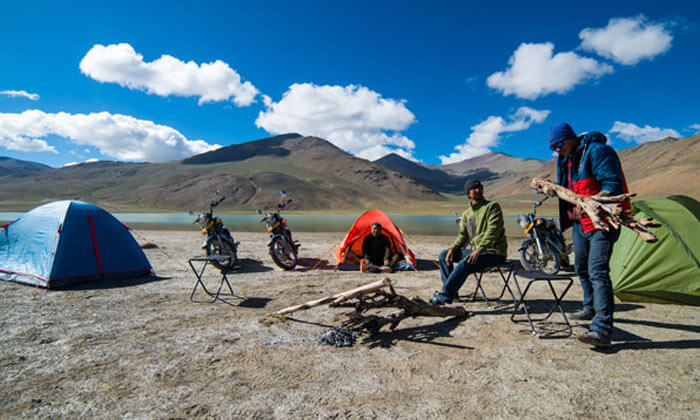
3. Tso Moriri, Ladakh - Best for Serious, High-Altitude Camping
Tso Moriri is 15,000 feet above sea level in the Rupshu Valley, and it looks nothing like anywhere else in India. The lake is 29 km long, brilliant blue-green, and completely encircled by barren mountains and sky. Migratory birds - bar-headed geese, black-necked cranes, brahminy ducks - use it as a stopover, and if you're lucky, you might spot a Tibetan wolf on the ridge.
There are no towns here. The nearest village is Korzok, a small settlement on the lake's northwestern edge. Accommodation is basic - camps and homestays only. That isolation is the entire point.
Altitude sickness is a real concern. Acclimatize in Leh for at least two days before attempting Tso Moriri (the lake sits higher than Leh). Don't rush it.
Best time: June to September. The road is impassable in winter.
Best for: Experienced campers, photographers, wildlife watchers, solo adventurers.
Permits needed: Inner Line Permit (ILP) for Indian nationals, Protected Area Permit (PAP) for foreign nationals - both obtainable online via the Ladakh Tourism portal. Distance from Leh: ~220 km.
4. Mussoorie, Uttarakhand - Best for Families and Beginners Near Delhi
Mussoorie gets overlooked as a camping destination because it's better known as a hill station. But at 7,000 feet in the Garhwal Himalayas, the camps here - set in pine and cedar forests with views of snow-covered peaks - are genuinely lovely and very well-suited to families, first-timers, or anyone who wants nature without extreme commitment.
Popular options include Mussoorie Adventure Camp and Camp George Everest, both offering ziplining, rope courses, hiking, bonfires, and basic to mid-range accommodation. Easy to reach from Delhi (280 km), easy to navigate, and suitable for all ages.
Best time: March to June, September to November.
Best for: Families, school groups, first-time campers.
Distance from Delhi: ~280 km.
Permits needed: None for standard private campsites.
5. Chandratal Lake, Himachal Pradesh - Best for Dramatic, Remote Camping
Chandratal is what happens when you remove every tourist convenience and replace it with pure landscape. The "Moon Lake," at 4,300 meters in Lahaul and Spiti, is a crescent of impossible blue water surrounded by high-altitude desert. No town. No shops. Nothing but the lake, the wind, and the mountains.
Getting there involves coming down 15 km of single-lane road from Kunzum Pass - just wide enough for one vehicle, with a vertical drop on one side. The only accommodation in the lake area is campsites. Losar, the nearest town, is several kilometers back.
The Himachal eco-tourism policy (2025) has tightened rules here. Camp only in designated areas, carry all waste out, and book through certified operators who hold valid Forest Department permits. Fires are allowed only in the camp's designated pit.
Best time: Late June to early October. Snowbound before and after.
Best for: Experienced campers, Spiti road-trippers, photographers. Altitude: 4,300 meters - serious acclimatization required.
Permits: Spiti Valley restricted area permit required for some routes.
6. Sonamarg, Jammu & Kashmir - Best for Green Valley and Glacier Camping
Sonamarg - "Field of Gold" - sits at 9,000 feet in Kashmir, named for the yellow wildflowers that blanket the meadows in summer. The Sindh River runs through it, glaciers sit visible on the surrounding ridgelines, and the trekking options include Vishansar Lake, Krishnasar Lake, and the Gangabal circuit.
Camping here means having the valley to yourself in early morning, before day-trippers arrive from Srinagar. The camps are basic - you'll need to bring your own sleeping bag and warm layers. Don't explore the surrounding forests alone at night; this is real wilderness.
Best time: May to October. Keep checking local security advisories - conditions in Kashmir change.
Best for: Trek-campers, nature lovers, couples. Distance from Srinagar: 87 km.
Permits needed: Foreigners need to register with local police on arrival in Kashmir.
7. Anjuna Beach, Goa - Best for Beach Camping
Anjuna is Goa's most famous beach camping destination, and it earns its reputation. Camping here is relaxed, colorful, and social - bonfires in the evening, the Arabian Sea in front of you, and the weekly flea market a short walk away. It's the most accessible camping experience in India, requiring zero gear and zero planning beyond showing up.
Options range from basic tent pitches to organized glamping setups. Activities include water sports, snorkeling, hiking to Vagator headland, and exploring the area's night market. It's not solitude - Anjuna gets busy - but the beach itself is beautiful and the vibe is genuinely festive.
Best time: November to February. The rest of the year is hot, humid, or monsoon-affected.
Best for: Groups, couples, backpackers, anyone wanting a beach camping experience.
Note: Always camp in authorized areas. Beach camping without permission on private land is not allowed.
8. Coorg (Kodagu), Karnataka - Best for Forest and Plantation Camping
Coorg is where you camp surrounded by coffee. The Kodagu district in Karnataka's Western Ghats is dense with plantation forests, misty valleys, and rivers - and camping here means waking up to the smell of coffee blossoms and birdsong rather than vehicle exhaust.
Popular sites include Dubare Elephant Camp (on the Cauvery River), Madikeri forest camps, and plantation-based stays near Kushalnagar. This is a gentler style of camping - more forest immersion than extreme adventure, better suited to those who want nature without altitude or roughness.
Best time: October to May. Monsoon (June-September) is intense in Coorg but also hauntingly beautiful for those who don't mind rain. Best for: Families, nature lovers, wildlife enthusiasts. Distance from Bangalore: ~250 km. Permits needed: Forest camps may require Forest Department clearance; operators usually handle this.
9. Nameri, Assam - Best for Wildlife and Birdwatching Camping
Nameri National Park in the Eastern Himalayan foothills is one of India's most underrated camping destinations. The park sits in the foothills of Arunachal Pradesh and is home to 374 bird species - making it a paradise for birdwatchers - plus tigers, elephants, and the great hornbill.
The Nameri Eco Camp, run by an NGO alongside the Jia-Bhoroli River, is the park's only jungle lodge and remains one of the best-managed eco-camps in the country. Activities include guided jungle walks, river rafting on the Jia-Bhoroli, and early-morning birding sessions. The thatched lodges and camps are built to be unobtrusive in the forest.
Best time: November to April. Monsoon months see park closure.
Best for: Wildlife enthusiasts, birdwatchers, experienced eco-tourists. Permits needed: State Forest Department permit required. Book through the Eco Camp for hassle-free access.
10. Sam Sand Dunes, Jaisalmer - Best for Desert Camping
Sam Sand Dunes, 45 km from Jaisalmer, offers the most distinct camping experience in India. You're in the Thar Desert, and the dunes here are the real thing - towering, clean, and golden at sunrise and sunset. Nights are silent and cold. The Milky Way is visible with the naked eye. It's genuinely otherworldly.
Activities include camel safaris, jeep safaris into the dunes, traditional Rajasthani folk performances, and morning photography sessions at dawn. Most desert camps include dinner and breakfast, with options running from budget (₹1,500-₹2,500) to luxury tented resorts (₹8,000+). The camps cluster around two main dune systems.
Best time: October to March. Summer heat in Jaisalmer is brutal - avoid April through September unless you enjoy 45°C.
Best for: Families, couples, international travelers, photographers.
Distance from Jaisalmer town: 45 km.
Permits needed: None for standard desert camps.
The Camping Packing Checklist for India
What you need will vary by destination, but this covers the essentials across most Indian camping trips:
Shelter & Sleep: Tent (if not provided by camp), sleeping bag rated to at least 0°C for Himalayan sites, sleeping mat or pad.
Clothing: Moisture-wicking base layers, fleece or insulated jacket (mountains get cold even in summer), waterproof outer layer, warm hat and gloves for high-altitude, sturdy trekking shoes with ankle support.
Safety & Hygiene: First aid kit, water purification tablets or LifeStraw, sunscreen (minimum SPF 50 - mountain sun is harsh), headlamp with spare batteries, mosquito repellent for forest or coastal camps.
Documents: Government-issued photo ID (Aadhaar/Driving Licence/Passport). For restricted areas: ILP/PAP permit printouts, health certificate if required, Forest Department permits. Carry multiple photocopies.
Leave No Trace essentials: Reusable water bottles (no plastic), biodegradable soap, garbage bags to carry out all waste.
Optional but highly recommended: Trekking poles for high-altitude camps, portable power bank, offline maps (Google Maps or Maps.me downloaded in advance for remote areas).
India has enough diversity for a lifetime of camping trips. Desert one winter, Himalayan meadow the next summer, forest camp in the monsoon off-season. The destinations above cover the full range — from gear-free beach glamping in Goa to the kind of high-altitude isolation that reminds you how small you actually are.
Pick one. Plan properly. Go.
Suggested Post
People Also Ask
No. Camping in notified forest areas, national parks, and wildlife sanctuaries without a valid permit is illegal and carries fines. Always camp in designated areas or through authorized operators. For open land outside protected areas, check with local authorities before pitching a tent.
It depends on where you're going. Designated private campsites and most beach camps don't require individual permits. National parks, wildlife sanctuaries, and restricted zones like Spiti, Tso Moriri, or parts of Arunachal Pradesh require State Forest Department or area-specific permits. Book through certified operators - they handle the paperwork.
October to June covers most of India well, but it varies by region. The Himalayas are best April-June and September–October. Rajasthan desert camps are best October–March. Goa and coastal camps are best November-February. The northeast (Assam, Sikkim) is best November–April. Avoid peak monsoon (July-August) for mountain treks - trails become dangerous.
Rishikesh, Mussoorie, and Solang Valley (Manali) are the most accessible for first-timers. All have well-organized camps, on-site food, activities, and easy connectivity. No special permits or trekking experience required.
Generally yes, particularly at organized campsites. Solo camping in remote wilderness areas without a guide is risky and in some protected areas is not permitted. If you're going solo into high-altitude or remote terrain, always register with the local forest office or police, share your itinerary with someone, and carry a fully charged phone with offline maps.
Organized campsites - especially well-reviewed ones in Rishikesh, Manali, Coorg, and Goa - are generally safe for solo women travelers. Choose camps with other guests, verified staff, and good reviews. Avoid unknown, isolated sites without prior research. Women-only camping groups and organized treks are also widely available through platforms like Thrillophilia and Trek the Himalayas.
In addition to the standard checklist: a sleeping bag rated below -5°C, altitude sickness medication (consult a doctor before travel - Diamox is commonly used), an extra warm layer, water purification tabs (water sources at altitude may be contaminated), and a basic first aid kit with bandages, antiseptic, and pain relief. Acclimatize properly - do not ascend more than 500 meters per day above 3,000 meters.
Budget camps start at ₹500-₹1,500 per person per night (basic tent, shared facilities). Mid-range organized camps with meals run ₹2,000-₹5,000. Luxury glamping or desert resort experiences can go from ₹6,000 to ₹20,000+. Prices rise 20-40% during peak season (October–January for most destinations, May–June for Himalayan sites).
Not independently. All national parks require visitors to camp through authorized operators holding valid State Forest Department permits. Independent camping inside park boundaries is prohibited under the Wildlife Protection Act, 1972. Fines can be substantial. Use a verified operator who provides documentation.
Leave No Trace means carrying all your waste out of the campsite, not disturbing wildlife, not making open fires outside designated fire pits, and leaving the area exactly as you found it. In many protected areas - especially national parks, Spiti, Chandratal, and Uttarakhand forest zones - violations result in fines. Some Himachal sites impose a ₹2,500 penalty for camping in unauthorized spots or littering.
Tso Moriri (Ladakh), Chandratal (Himachal Pradesh), Sam Sand Dunes (Jaisalmer), and Spiti Valley are the top four. All sit in areas with minimal light pollution and dry, clear skies for much of the year. Spiti's Kibber and Komic villages, in particular, have been popular with astronomy photographers for years.
Foreigners can camp at standard private sites with no additional requirements beyond a valid visa and passport. For restricted areas (parts of Ladakh, Arunachal Pradesh, Sikkim border regions), OCI holders and foreign nationals require Protected Area Permits (PAP) or Restricted Area Permits (RAP), which are obtained through a licensed Indian tour operator or the Foreigners Regional Registration Office (FRRO). Note: Some areas in Ladakh are closed to foreign nationals entirely.