
10 Best Things to Do in Rameswaram: Temples, Beaches, and Scenic Views

Priya Sharma
Travel Writer & Adventure Enthusiast
Rameswaram is one of those rare places in India where a trip can feel deeply spiritual and visually dramatic at the same time. On one side, you have one of the holiest Shiva shrines in the country, sacred sea baths, and temple rituals that draw pilgrims from across India. On the other, you have sea bridges, windswept coastal roads, quiet viewpoints, ruined towns, and some of the most memorable island scenery in South India. That blend is what makes Rameswaram more than just a temple stop. It is a destination that works for pilgrims, families, road trippers, photographers, and anyone interested in places shaped by myth, history, and the sea.
If you are rewriting this page to rank better, the most important shift is this: do not treat Rameswaram as only a list of attractions. The page needs to help the reader understand what to do first, what to pair together, when to visit, and which places are truly worth the time. That is where many generic competitor pages stay shallow. A better guide should help someone plan a smooth one-day or two-day trip, not just scroll through names.
Quick Planning Tips Before You Start
For most travellers, 1 to 2 days is enough for the main Rameswaram circuit. If your focus is spiritual, begin with Agnitheertham and Ramanathaswamy Temple early in the day. If your focus is sightseeing, combine Pamban Bridge, Kalam Memorial, Dhanushkodi, and Kothandaramaswamy Temple in one scenic route. The official Ramanathaswamy Temple site currently lists temple hours as 4:00 a.m. to 1:00 p.m. and 3:00 p.m. to 8:00 p.m., while the 22 theertham bathing window runs from 5:30 a.m. to 12:30 p.m. and again from 3:00 p.m. to 7:00 p.m.
-
Best overall season: October to March for more comfortable weather
-
Best time of day for scenic stops: sunrise and sunset
-
Best pace: stay one night if you want both temple time and coastal sightseeing without rushing
-
Temple note: photography restrictions are taken seriously in many temple areas, so do not assume cameras are allowed everywhere.
1. Seek Blessings at Arulmigu Ramanathaswamy Temple
No list of things to do in Rameswaram can begin anywhere else. Ramanathaswamy Temple is the spiritual heart of the town and the main reason many people travel here. It is one of the most revered Shiva shrines in India, part of the Char Dham pilgrimage circuit, and closely tied to the Ramayana. Incredible India highlights it as one of the island’s most important attractions and notes its extraordinary corridor, which stretches about 1,200 metres and is lined with 1,212 sculpted pillars. That alone makes it one of the most visually striking temple interiors in the country.
This is not just a place to see. It is a place to experience slowly. The temple’s scale, rhythm, and ritual atmosphere are what make it special. If you are visiting as a pilgrim, this will likely be your main stop. If you are not, it is still the one place in Rameswaram that you should not skip, because it explains why the island matters so deeply in Indian sacred geography. The official temple site also makes this stop more practical than many articles suggest, because timings are clear and current.
What makes it special
-
One of India’s holiest Shiva temples
-
Famous for its long pillared corridors and sacred wells
-
Deep mythological link to Lord Rama and the Ramayana
Helpful tip
If you want to do the 22 theertham ritual bathing, go earlier in the day and carry a change of clothes. The official temple service page currently lists the theertham bath fee at ₹25 per person.
2. Take a Holy Dip at Agnitheertham
Agnitheertham is the sea-facing sacred bathing spot just outside the temple and is one of the most meaningful experiences in Rameswaram. Incredible India specifically describes taking a dip at Agni Teertham before proceeding into the temple precincts, and that sequence is exactly how many pilgrims approach the visit. Even for non-pilgrims, this stop has value. The sea is calm compared with many other coastal stretches, sunrise here is beautiful, and the devotional atmosphere along the shore gives you a strong sense of what Rameswaram means to the people who come here.
This is one of the clearest competitor gaps to address properly. Many articles mention Agnitheertham in one line and move on. A better version should explain why it matters. It is not just a beach near the temple. It is part of the pilgrimage sequence and one of the most emotionally charged places in town, especially at dawn.
3. Experience the Crossing Over Pamban Bridge
Pamban Bridge is one of the defining images of Rameswaram. Tamil Nadu Tourism calls it one of India’s finest engineering marvels and highlights its status as the first sea bridge built across the sea in India. Incredible India also positions it as one of the key experiences that links the sacred island to the mainland. Whether you cross it by road or catch a train across the older rail section, this is one of those moments that makes the trip feel larger than a temple visit. The sea on both sides, the open horizon, and the sense of entering an island town all make it memorable.
This is another area where weaker articles stop too early. Do not just say “visit Pamban Bridge.” Tell readers to slow down, use it as an arrival experience, and plan a photo stop or a return crossing around sunrise or sunset if possible. That practical layer is what makes the page more useful than a generic attraction list.
Best way to enjoy it
-
Cross it slowly if coming by road
-
Watch for sea colour changes and fishing boats below
-
Try sunrise or late afternoon for the best light
4. Drive to Dhanushkodi and Feel the End-of-the-Landscape Magic
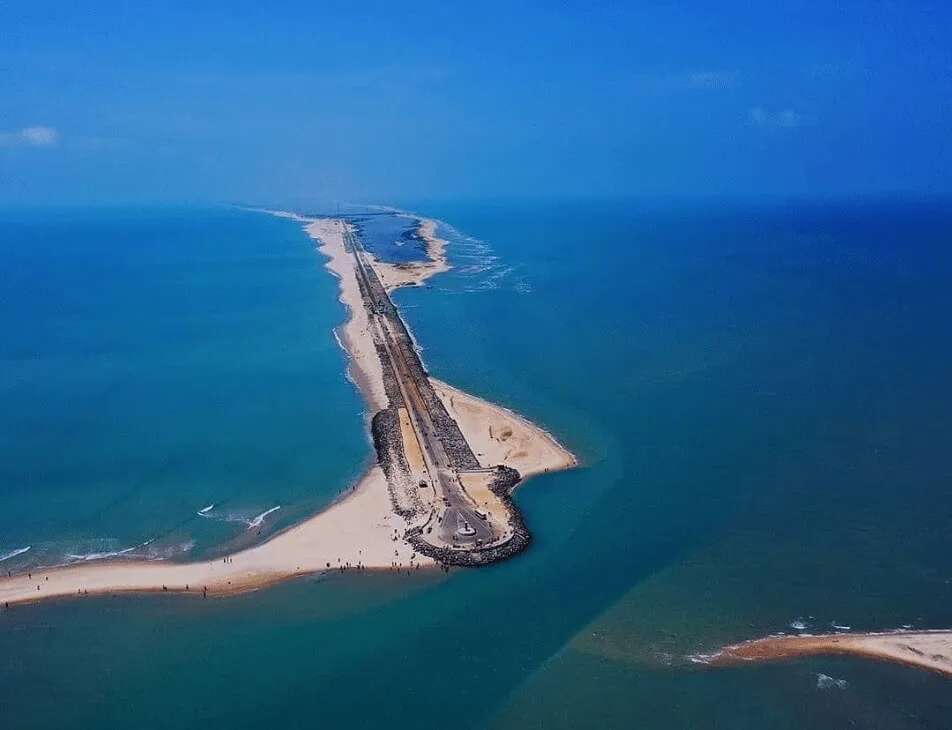
Dhanushkodi is one of the biggest reasons casual travellers fall in love with Rameswaram. Tamil Nadu Tourism describes it as a long beach destination known for high tides, migratory birds, and access to nearby points of interest, while Incredible India frames it as the dramatic end point where the Bay of Bengal meets the Indian Ocean. The ruined-town atmosphere, the long approach road with sea on both sides, and the feeling of standing near the very edge of the island make this one of the most unforgettable outings in Tamil Nadu.
Your existing draft includes Dhanushkodi, which is good, but the stronger version should emphasize that the drive itself is part of the attraction. This is not only about ruins. It is about the coastal approach, the openness, the wind, and the landscape that feels unlike almost anywhere else in mainland India. Recent traveller reviews also keep praising the sheer beauty of the road and the meeting of the waters.
Why it stands out
-
One of the most scenic road stretches in South India
-
Destroyed-town history adds emotional weight to the visit
-
Strong spiritual significance linked to Ramayana traditions
5. Visit the Rama Setu View Area Near Dhanushkodi
Many travellers separate Dhanushkodi and Rama Setu into two points, but the more helpful way to write it is as a linked experience. The Ram Setu legend is one of the reasons the entire Rameswaram area carries such mythological power. Incredible India directly references the region’s association with the bridge believed to have once linked India and Sri Lanka. That means readers do not just want a beach outing here. They want to feel the story attached to the coastline.
Instead of overselling it as a single sharply defined tourist stop, write it honestly. You are visiting a symbolic and scenic area tied to one of the most famous sacred narratives in India. That makes it a stronger, more trustworthy addition than exaggerated claims about “walking on the bridge” or treating it like a normal monument.
6. Climb Gandhamadhana Parvatham for a Panoramic View of Rameswaram
Gandhamadhana Parvatham is one of the best additions for a stronger article because it fills a real competitor gap: viewpoint intent. Incredible India describes it as the highest point on the island and connects it with Lord Rama’s story, while also noting the panoramic view it offers over the region. That makes it valuable for both pilgrims and non-pilgrims.
If you want one stop in Rameswaram that helps people visually understand the island, this is it. It breaks the pattern of temple-beach-temple and gives the article more variety. That variety matters for rankings too, because the keyword is not just spiritual. A large chunk of searchers want scenic things to do in Rameswaram, and this is one of the clearest answers.
7. Stop at Villoondi Theertham for a Quiet Coastal Pause
Villoondi Theertham is one of the quieter and more meaningful places around Rameswaram. Incredible India links it to the Ramayana episode in which Lord Rama is believed to have brought forth fresh water from the sea to quench Sita’s thirst. Even travellers who are not deeply religious tend to find the setting calm and reflective.
This is exactly the kind of place that improves the article’s quality. It is not as dramatic as Dhanushkodi and not as grand as Ramanathaswamy Temple, but it gives the trip breathing space. In a better itinerary, this is where people slow down instead of rushing from one high-profile sight to the next.
8. Visit Kothandaramaswamy Temple on the Dhanushkodi Side
This is one of the most important upgrades to the page. Many generic lists miss Kothandaramaswamy Temple, but Incredible India specifically highlights it as the place where Vibhishan is believed to have sought refuge with Lord Rama and where he was later crowned king of Lanka. It also notes that the temple survived the 1964 cyclone that devastated the surrounding region. That gives it a rare combination of mythological importance and historical survival.
For search quality, this is a stronger inclusion than lighter filler attractions because it adds depth and narrative. It also pairs naturally with Dhanushkodi, making that side of the island feel like a fuller outing rather than a single-point drive. If someone only follows one improvement from competitor gaps, this should be one of them.
9. Explore Panchamukhi Hanuman Temple and the Floating Stones Display
Panchmukhi Hanuman Temple is one of the most talked-about religious stops outside the main temple circuit. Incredible India highlights it as a five-faced Hanuman shrine and notes the floating stones displayed there, which are tied in local tradition to the building of Ram Setu. Whether a visitor approaches it through faith, curiosity, or both, it is one of the most distinctive short stops in Rameswaram.
This stop works especially well for families and first-time visitors because it is easy to understand, easy to include, and different enough from Ramanathaswamy Temple to feel like a separate experience rather than a repeat. That makes it a smart inclusion for both readers and rankings.
10. Visit the Dr. A.P.J. Abdul Kalam Memorial
Rameswaram is not only about epic mythology and temple pilgrimage. It is also the hometown region of Dr. A.P.J. Abdul Kalam, and the memorial dedicated to him adds a meaningful modern layer to the destination. Tamil Nadu Tourism notes that the memorial is spread over 2.11 acres and was inaugurated in 2017, while the district administration and Incredible India both highlight it as an important attraction that celebrates his life and contributions.
This stop is especially useful because it broadens the article beyond purely religious travel. It makes the page more balanced, more family-friendly, and more interesting for readers who want a fuller view of Rameswaram rather than only a temple checklist.
How to Plan These 10 Things in 1 or 2 Days
This is one of the biggest gaps in most competitor articles, so it is worth adding clearly.
If you have 1 day in Rameswaram
-
Start with Agnitheertham and Ramanathaswamy Temple early
-
Visit Panchamukhi Hanuman Temple and Gandhamadhana Parvatham
-
After lunch, drive to Kalam Memorial, Pamban side viewpoints, and Dhanushkodi
If you have 2 days in Rameswaram
-
Day 1: Temple-focused route with Agnitheertham, Ramanathaswamy Temple, Panchamukhi Hanuman Temple, and Gandhamadhana Parvatham
-
Day 2: Pamban Bridge, Kalam Memorial, Villoondi Theertham, Kothandaramaswamy Temple, Dhanushkodi, and Rama Setu viewing side
Best Time to Visit Rameswaram
The most comfortable time to visit is usually from October to March, when the weather is easier for temple visits and coastal drives. Summer can feel harsh in the middle of the day, and the open stretches toward Dhanushkodi can become uncomfortable if the heat is strong. Sunrise and sunset remain the best times for the scenic parts of the trip, especially Pamban Bridge, Gandhamadhana Parvatham, and Dhanushkodi.
What Makes Rameswaram Special
Rameswaram stands out because almost every major stop has more than one layer. Ramanathaswamy Temple is both an active pilgrimage centre and an architectural marvel. Agnitheertham is both a beach and a sacred ritual point. Pamban Bridge is both infrastructure and an experience. Dhanushkodi is both a scenic coast and a place shaped by memory. That layering is what makes Rameswaram so rewarding. It never feels like a destination with only one type of traveller in mind.
Conclusion
The best things to do in Rameswaram are not just about checking off famous names. The real magic of the town comes from how naturally its temples, beaches, myths, and sea views connect with each other. A good Rameswaram trip should feel balanced. Give time to the temple, make space for the coast, and do not rush the Dhanushkodi side. If planned well, even a short stay here can feel much richer than many longer trips elsewhere.
People Also Ask
For most travellers, the top experience is visiting Arulmigu Ramanathaswamy Temple because it is the spiritual and cultural centre of Rameswaram.
One day is enough for the main highlights, but two days is better if you want both temple experiences and scenic places like Dhanushkodi, Pamban Bridge, and Villoondi Theertham.
Yes. It is one of the most memorable parts of a Rameswaram trip because of the coastal drive, ruined-town atmosphere, and dramatic meeting of the waters.
Early morning is usually best, especially if you want a quieter visit or plan to do ritual bathing before darshan. The official temple timings currently begin at 4:00 a.m.
Families usually enjoy Ramanathaswamy Temple, Pamban Bridge, Dhanushkodi, Panchamukhi Hanuman Temple, and the Abdul Kalam Memorial most.