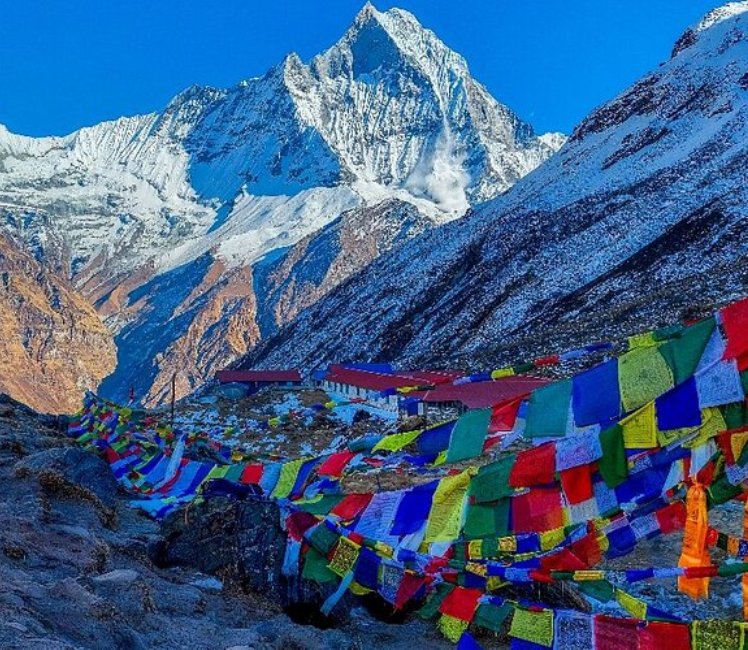

The Annapurna Base Camp Trek - also known as the Annapurna Sanctuary Trek - is the most rewarding moderate trek in Nepal. In just 11 days, Indian trekkers walk into the heart of the Annapurna massif to stand at 4,130 metres in a natural amphitheater of giants: Annapurna I (8,091m - the world's 10th highest mountain), Annapurna South, Gangapurna, Hiunchuli, and the unmistakable fishtail silhouette of Machhapuchhre (6,993m). Unlike Everest Base Camp, this trek does not require prior high-altitude experience, making it the ideal first Himalayan trek for Indian adventurers.
The Annapurna Base Camp trek cost for Indians in 2026 which includes everything: all meals from Day 1 to Day 11 (breakfast, lunch, and dinner), teahouse accommodation throughout the trek, government-licensed guide, one porter for every two trekkers, the Annapurna Conservation Area Permit (ACAP), farewell dinner in Kathmandu, and a trek completion certificate. TriptoOcean's package offers significant savings for trekkers while maintaining the same and often higher quality of service.
The route passes through traditional Gurung and Magar villages where time moves slowly - terraced rice fields, stone-paved paths, prayer flags, and warm teahouse hospitality frame every day of the walk. You cross suspension bridges above the Modi Khola river, trek through the world's largest rhododendron forests that bloom crimson and pink in spring, and descend on the return journey to the natural hot springs of Jhinu Danda — one of the most beloved trail rewards in all of Nepal trekking. The full journey from Kathmandu to Pokhara and back is managed by TriptoOcean end to end.
The Everest Base Camp Trek (5,364m) is the more famous name, but the Annapurna Base Camp Trek (4,130m) is the smarter choice for most Indian trekkers doing their first high-altitude Himalayan trek. ABC reaches a lower maximum altitude than EBC - reducing altitude sickness risk significantly. The trail is shorter (11 days vs 12–14 days), more affordable rates, warmer and greener in character, and delivers an equally powerful mountain amphitheater experience at base camp. The return via Jhinu Danda hot springs is something no EBC itinerary can match. For Indian trekkers choosing their first Himalayan challenge, ABC is the right call.
Arrive at Tribhuvan International Airport, Kathmandu. A TriptoOcean representative meets you at arrivals with a name board and transfers you to your hotel. Take the rest of the day to rest, settle in, and adjust after your flight.
In the evening, your TriptoOcean trek leader conducts a comprehensive pre-trek briefing - covering the 11-day route, daily distances, altitude profile, altitude sickness prevention, packing priorities, permit documentation, and what to expect at teahouses along the trail. This briefing is where your Annapurna adventure begins.
Explore Thamel in the evening - Kathmandu's vibrant traveller's hub - for any last-minute gear purchases, currency exchange, or simply to absorb the city's extraordinary atmosphere.
Overnight: Hotel in Kathmandu | Meals: Dinner
After breakfast, board a tourist bus from Kathmandu to Pokhara (820m) - Nepal's lakeside city and the gateway to the Annapurna region. The Prithvi Highway follows the Trishuli and Marsyangdi rivers through scenic hill country for approximately 6-7 hours.
Arriving in Pokhara in the afternoon, check in to your hotel on the lakeshore. If the skies are clear, you can see the Annapurna range - including the distinctive fishtail silhouette of Machhapuchhre - directly from Pokhara. The mountain you have come to trek to is already watching you arrive.
Spend the evening by Phewa Lake, browsing the Lakeside restaurants and shops. Pokhara is the last proper town before the trail begins - enjoy it.
Overnight: Hotel in Pokhara | Meals: Breakfast | Note: Lunch and dinner in Pokhara at own cost
After breakfast, drive from Pokhara to Nayapul (1,070m) - approximately 1-1.5 hours by jeep or bus. At Nayapul, ACAP permits are checked at the Birethanti checkpoint. The trek begins here.
Follow the Modi Khola river valley trail, crossing suspension bridges and passing through small settlements to reach Ghandruk (1,940m) - one of the most beautiful Gurung villages in the Annapurna region. Ghandruk is a living museum of Gurung culture, with slate-roofed stone houses, intricately carved doorways, and warm local hospitality that has welcomed trekkers for decades.
From Ghandruk, the views of Annapurna South (7,219m) and Hiunchuli (6,441m) are your first proper taste of what lies ahead. Your guide will introduce you to the trail rhythm and begin the altitude monitoring routine.
Overnight: Teahouse in Ghandruk | Meals: Breakfast, Lunch & Dinner
Continue from Ghandruk on a trail that descends into the valley before climbing steadily to Chomrong (2,170m) - the last major Gurung village before entering the Annapurna Sanctuary proper. Chomrong sits on a ridge with spectacular views of Annapurna South and the Modi Khola valley below.
Chomrong is also the last place on the trail with reliable ATM access and good mobile network coverage. Stock up on cash and make any calls home - communication becomes intermittent from here onwards.
The 9km trek involves a significant ascent in the final section. Take it slowly, stay hydrated, and follow your guide's pace. Your body is beginning to adapt to increasing altitude.
Overnight: Teahouse in Chomrong | Meals: Breakfast, Lunch & Dinner | Trek: 9 km, 4-5 hrs
This is the most demanding ascent day of the trek. From Chomrong, the trail descends briefly before climbing through Sinuwa, Bamboo, and Dovan - a sequence of teahouse settlements nestled in increasingly dense bamboo and rhododendron forest. The forest here is extraordinary - ancient, wet, and alive with birds.
From Dovan, the trail climbs steeply through the Himalayan landslide zone to reach Deurali (3,174m). The altitude gain is significant - approximately 1,000 metres in one day - so your guide will monitor your condition carefully throughout. Altitude sickness prevention here: walk slowly, drink 3-4 litres of water, and eat well.
By the time you reach Deurali, you are above the treeline and entering the lower Annapurna Sanctuary. The landscape shifts dramatically - larger boulders, snow patches in winter, and the first clear views of the sanctuary walls emerging above.
Overnight: Teahouse in Deurali | Meals: Breakfast, Lunch & Dinner | Trek: 8 km, 5- 6 hrs
This is the day you have been trekking towards. From Deurali, the trail follows a steady climb through glacial moraine into the heart of the Annapurna Sanctuary - a high mountain basin so completely enclosed by peaks that it feels like a different world.
The first milestone is Machhapuchhre Base Camp (MBC, 3,700m) - the base of the iconic Fishtail Mountain. Machhapuchhre is Nepal's most sacred unclimbed peak - closed to all climbing expeditions due to its religious significance. Its distinctive twin-pronged summit, viewed from directly below at MBC, is unforgettable. Rest here for an hour, acclimatize, have lunch, and let your guide check oxygen saturation levels.
From MBC, the final push to Annapurna Base Camp (4,130m) takes 1.5-2 hours through a wide, open glacial valley. As you approach ABC, the Annapurna Sanctuary reveals itself fully - a 360-degree amphitheater of Himalayan giants surrounding you on all sides. Annapurna I (8,091m), Annapurna South (7,219m), Gangapurna (7,455m), Annapurna III (7,555m), Hiunchuli (6,441m) and the Fishtail above it all. This is one of the most powerful natural settings accessible to trekkers anywhere on Earth.
Arrive at ABC in the afternoon, check in, rest, and spend as long as you need absorbing what surrounds you. Watch the alpenglow turn the peaks gold and orange as the sun descends. This moment is why you trekked here.
Overnight: Teahouse at Annapurna Base Camp | Meals: Breakfast, Lunch & Dinner
Wake early for the ABC sunrise - the Annapurna peaks illuminated in the first light of morning is a sight that trekkers consistently describe as the single most beautiful moment of their Nepal journey. Take photos, drink tea, stand in the silence.
Begin the descent after breakfast. The body feels lighter at lower altitude, and the downhill journey through MBC, Deurali, Dovan, and all the way to Bamboo (2,310m) takes 6-7 hours. The long descent is easier on lungs but harder on knees - trekking poles are recommended.
Bamboo is a small settlement named for the dense bamboo groves surrounding it. It has a peaceful, quiet character that is a welcome contrast to the high-altitude intensity of the previous days. Rest well - the hot springs await tomorrow.
Overnight: Teahouse in Bamboo | Meals: Breakfast, Lunch & Dinner | Trek: 13 km, 6–7 hrs
The most eagerly anticipated section of the descent. Trek from Bamboo through lush forests and terraced fields, descending steadily to Jhinu Danda (1,780m) - the trekking trail's most beloved reward.
Jhinu Danda is famous throughout the Annapurna region for its natural hot springs on the bank of the Modi Khola river. After 7-8 days of trekking, soaking tired muscles in the geothermal pools while the river rushes below you is an experience that has become a defining memory for thousands of Indian trekkers who have done the ABC route. Allow yourself at least 1-2 hours at the hot springs before continuing to your teahouse for the night.
Overnight: Teahouse at Jhinu Danda | Meals: Breakfast, Lunch & Dinner | Trek: 8 km, 4-5 hrs
Trek the final trail section from Jhinu Danda towards Siwa / Ghandruk Phedi (1,150m) - approximately 4 km, 3–4 hours along the Modi Khola road. This part of the trail runs through lush river valley scenery and terraced farmland - a gentle, satisfying final walk.
From Ghandruk Phedi, drive via Birethanti and Nayapul back to Pokhara (820m) - approximately 2–3 hours by jeep. Arriving in Pokhara, your trekking journey ends and city comforts resume. Hot shower, proper restaurant meal, and the beautiful lakeside atmosphere of Pokhara await.
Overnight: Hotel in Pokhara | Meals: Breakfast | Lunch and dinner in Pokhara at own cost
Return to Kathmandu from Pokhara by tourist bus (approximately 6-7 hours) or by domestic flight (30 minutes - at additional cost). Arrive in Kathmandu and check in to your hotel for the final night.
The evening features a farewell dinner hosted by TriptoOcean at a traditional Nepali restaurant in Kathmandu - a celebration of what you and your fellow trekkers have accomplished together. Trek completion certificates are distributed at the dinner. It is the kind of evening that Indian trekkers remember long after they return home.
Overnight: Hotel in Kathmandu | Meals: Breakfast & Farewell Dinner
After breakfast, depending on your flight departure time, a TripToOcean representative transfers you to Tribhuvan International Airport, Kathmandu for your onward flight. End of services.
If your flight is late in the day, use the morning for any last-minute shopping in Thamel - singing bowls, Pashmina shawls, thangka paintings, and Himalayan teas are among the most popular souvenirs Indian trekkers carry home from Nepal.
Meals: Breakfast
TriptoOcean handles all permits on your behalf - you do not need to visit any office.
| Annapurna Conservation Area Permit (ACAP) | ₹820 (Indians) | NPR 3,000 (Others) | Mandatory |
| Licensed Guide (mandatory since April 2023) | Included in package | Mandatory |
| TIMS Card (Trekkers Info Management System) | No longer required | NA |
What is included in all packages:
Not included:
The ABC trek is classified as Moderate - it is the most beginner-friendly of the major Himalayan base camp treks and is completed every season by thousands of first-time high-altitude trekkers from India. You do not need prior trekking experience. You do need reasonable physical fitness and the willingness to walk 5-7 hours per day for 7 consecutive trekking days.
The main challenges are cumulative physical effort over multiple days and altitude gain - particularly on Day 5 (Chomrong to Deurali, +1,000m). Your TriptoOcean guide monitors blood oxygen saturation levels twice daily from Day 5 onwards using a pulse oximeter and follows strict altitude safety protocols.
Altitude Sickness (AMS) - what Indian trekkers need to know:
| Season | Months | Weather | Views | Verdict for Indians |
|---|---|---|---|---|
| Autumn ★ Best | Sep-Nov | Clear, crisp, cool | Exceptional - sharpest skies | Best for first-timers. October is the gold standard. |
| Spring ★ Excellent | Mar-May | Warm, rhododendrons blooming | Excellent - colourful trails | Best for photographs. April is peak bloom month. |
| Winter | Dec-Feb | Cold, snow possible at ABC | Good on clear days | Quiet trails, fewer trekkers. Prepare for cold gear. |
| Monsoon | Jun-Aug | Heavy rain, leeches | Limited, cloudy | Not recommended. Trails slippery, views restricted. |
Indian school holidays align well: October-November departures work for Diwali and post-Navratri travel. March-April departures work for Holi holiday and summer break planning. TriptoOcean runs group departures on fixed dates - contact us for the 2026 departure schedule.
Your porter carries the main duffel bag (max 9 kg per person, 18 kg combined per porter). You carry your daypack (5–7 kg maximum). Pack light — every extra kilogram matters by Day 5.
| Category | Essential Items |
|---|---|
| Footwear | Waterproof ankle-support trekking boots (broken in before departure), teahouse sandals, gaiters (optional, useful above 3,500m) |
| Clothing | Thermal base layers (×2), fleece mid-layer, down jacket (-10°C rated), waterproof Gore-Tex shell, trekking pants (×2), trekking shirts (×3), warm hat, buff, liner gloves + warm gloves, trekking socks (×5-6 pairs) |
| Equipment | Trekking poles (essential for knee protection on descent), sleeping bag (-10°C rated - can rent in Kathmandu/Pokhara), daypack (25-30L), main duffel (50L for porter), headlamp + spare batteries, high-capacity power bank |
| Health & Safety | Pulse oximeter (self-monitor), first aid kit (blister pads, ibuprofen, rehydration salts, antiseptic), sunscreen SPF 50+, UV sunglasses, insect repellent, water purification tablets or SteriPen, 2 x 1L water bottles |
| Documents & Money | Passport (valid 6+ months) + multiple photocopies, travel insurance documents (physical + digital), INR/NPR cash (ATMs only in Chomrong area - carry NPR 15,000–20,000 minimum for trail expenses), permit copies (TripToOcean provides) |
| Misc | Camera, energy bars/dry fruits (trail snacks), personal hygiene items, wet wipes, hand sanitiser, reusable water bottle (single-use plastic discouraged in Annapurna Conservation Area) |
Note: Sleeping bags, trekking poles, and down jackets can be rented in Kathmandu (Thamel) or Pokhara at reasonable daily rates if you do not own them.
By Air: Fly into Tribhuvan International Airport (KTM), Kathmandu - well connected to Delhi, Mumbai, Kolkata, Bangalore, Chennai, Hyderabad, and Varanasi via Air India, IndiGo, SpiceJet, and Nepal Airlines.
By Road (from India): Popular land border crossings include Sunauli–Belahiya (from Gorakhpur) and Raxaul-Birgunj (from Bihar). Road journey from Sunauli to Kathmandu is approximately 8-10 hours.
Nepal Entry for Indians: No visa required. Valid Indian Passport or Voter ID Card accepted. Aadhaar Card is NOT valid for Nepal. Children under 16 need original Birth Certificate + School ID Card. INR 500+ denomination notes are prohibited in Nepal - carry INR 100 and below or exchange at Kathmandu airport.
The Annapurna Base Camp trek cost for Indians from TriptoOcean in 2026 starts at ₹99,000 per person for a minimum group of 10 (group joining available for solo Indian trekkers). Small groups of 4-9 pax are priced at ₹105,000 per person. Private/solo treks start at ₹1,15,000 per person. All rates include: all meals (breakfast, lunch, dinner) throughout the 11-day trek, teahouse accommodation, government-licensed guide, 1 porter per 2 trekkers, ACAP permit, farewell dinner in Kathmandu, trek certificate, and all government taxes. No hidden charges.
Yes. The ABC trek is classified as Moderate and is the most beginner-friendly of Nepal's major base camp treks. Thousands of first-time high-altitude trekkers from India complete it every season.
The maximum altitude is 4,130m - significantly lower than EBC (5,364m), which reduces altitude sickness risk considerably. No technical climbing skills are required - just the fitness to walk 5-7 hours daily and the discipline to follow your guide's pace. TripToOcean's licensed guides monitor blood oxygen levels twice daily from Day 5 onwards and follow strict altitude safety protocols.
No. The TIMS card is no longer required for the Annapurna region as of 2023. Many websites still show TIMS as mandatory - this is outdated information. In 2026, the only mandatory permit for the ABC trek is the Annapurna Conservation Area Permit (ACAP), which costs NPR 1,000 (approximately ₹820) for Indian (SAARC) nationals and NPR 3,000 for other foreign nationals. This permit is checked at the Birethanti checkpoint at the start of the trek. TriptoOcean includes the ACAP permit in the package price - no separate action required from you.
No. Solo trekking - meaning trekking without a licensed guide from a registered agency is banned across all of Nepal's national parks and conservation areas since April 2023. This regulation is actively enforced at checkpoints. Every trekker on the Annapurna Base Camp trail must be accompanied by a government-licensed guide booked through a registered agency. TripToOcean is a registered trekking agency - all our guides hold valid government licensing. Solo Indian travellers can join our group departures - this is our group joining option, which makes solo travel safe, affordable, and sociable.
Yes - and it is one of the most dramatic mountain encounters on the entire trek. Machhapuchhre (Fishtail, 6,993m) is visible throughout most of the ABC route, but it is at Machhapuchhre Base Camp (MBC, 3,700m) - which you pass on the way to ABC - that the mountain fills the sky above you completely. Its distinctive twin-peaked summit (the "fishtail" shape is most visible from Pokhara at distance) reveals its full vertical scale from MBC. Machhapuchhre is Nepal's most sacred unclimbed peak - no expedition has ever received permission to summit it. You can reach its base camp and look straight up at this untouched giant. From ABC, Machhapuchhre stands behind you as Annapurna I faces you head-on.
The two best seasons are Spring (March-May) and Autumn (September-November). October is the single best month - post-monsoon skies at their clearest, temperatures pleasant at all altitudes, and the Himalayan peaks at their most visible. April is excellent for spring rhododendron blooms - the trail through the Annapurna forests is covered in crimson and pink flowers that bloom at different altitudes as you ascend. For Indian travellers, October–November aligns well with Diwali and post-festive travel. March-April aligns with Holi holidays and summer vacation planning. Avoid June-August (monsoon) - trails are slippery, visibility is limited, and leeches are active at lower altitudes.
Yes. Group joining is available for solo Indian trekkers on TriptoOcean's ABC departures. You join an existing group of 10+ trekkers, share the licensed guide and porter support, and pay the group rate of ₹99,000 per person min 10 person - the most cost-effective way to do the ABC trek as a solo traveller. Contact TriptoOcean via WhatsApp (+91 8209951350) or the enquiry form on this page for upcoming group joining departure dates. A solo pax surcharge is applicable for fully private treks - see pricing table above.
For first-time Himalayan trekkers from India, ABC is the smarter choice. It is lower (4,130m vs 5,364m), shorter (11 days vs 12-14 days), more affordable (₹99,000 vs ₹1,15,000), warmer in character, and includes the Jhinu Danda hot springs - a return trail reward with no EBC equivalent. The base camp mountain amphitheater experience at ABC is equally powerful. EBC is the right choice for Indian trekkers who want maximum altitude bragging rights, want to stand where Hillary and Tenzing began their 1953 ascent, or are experienced trekkers seeking a harder challenge. Both are operated by TriptoOcean - see our Everest Base Camp Trek page for a full EBC comparison.