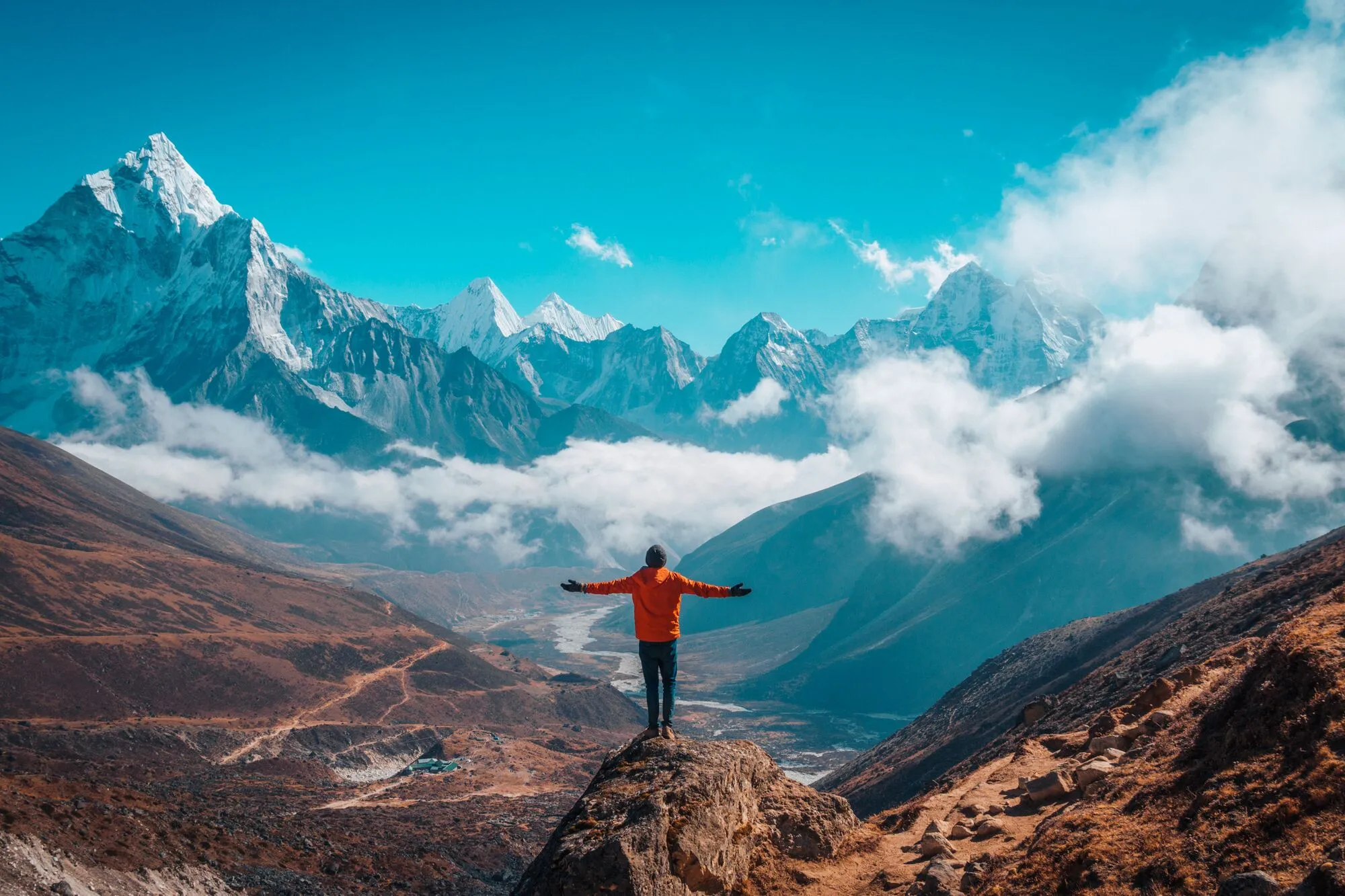

Not all treks are created equal. While most travellers explore the hills and beaches of India, the Everest Base Camp Trek takes you into the Himalayas of Nepal - to the very foot of the world's highest mountain, Mount Everest (8,849m). At 5,364 metres, Base Camp is where elite climbers prepare for summit attempts. For trekkers, it is the most iconic destination on Earth that does not require technical climbing skills.
This 12-day guided trek follows the legendary Khumbu trail from Lukla through Sherpa villages, ancient monasteries, and glacial moraines. You will cross swaying suspension bridges above the Dudh Koshi River, rest in warm teahouses below towering peaks, and share the trail with yaks, monks, and mountaineers. The route passes through Sagarmatha National Park - a UNESCO World Heritage Site - before climbing to the prayer-flag-draped rocks of Everest Base Camp.
The trek culminates at Kala Patthar (5,545m), where sunrise over the Himalayan range - Everest, Lhotse, Nuptse, Pumori all glowing gold - is widely considered the finest mountain panorama on the planet. Our licensed guides monitor your altitude acclimatisation daily, carry pulse oximeters, and follow strict safety protocols. All meals are provided throughout. This is not just a trek. It is the kind of trip that redefines what you believe you are capable of.
Planning an Everest Base Camp Trek from India in 2026? The first question every Indian traveller asks is straightforward: how much will this actually cost me? The honest answer is that EBC trek pricing varies significantly depending on what is included, who is operating the trek, and how many people are travelling with you. Here is everything you need to know before you compare packages.
Our 12-day Everest Base Camp Trek starts from ₹1,10,000 per person for group departures, and goes up to ₹1,55,000 per person for a fully private, solo-traveller arrangement. Small groups of 4-9 trekkers fall in the ₹1,25,000 per person range.
These are not bare-bones prices. Every rupee covers a complete, fully-managed trek, return Lukla flights from Kathmandu, all meals from Day 1 to Day 12, teahouse accommodation on the trail, a government-licensed English-speaking guide, one porter for every two trekkers, all three required permits (Sagarmatha National Park, Khumbu Pasang Lhamu, and TIMS Card), daily pulse oximeter checks for altitude safety, and a farewell dinner in Kathmandu. There are no hidden extras beyond personal expenses like hot drinks, charging fees, and tips.
| Trek Duration | 12 Days / 11 Nights |
| Maximum Altitude | Kala Patthar - 5,545m (18,192 ft) |
| EBC Elevation | 5,364m (17,598 ft) |
| Starting Point | Kathmandu → Lukla (2,860m) |
| Total Distance | ~130 km round trip |
| Difficulty | Moderate to Strenuous |
| Best Season | March–May (Spring) & September–November (Autumn) |
| Package Rate | ₹1,10,000 per person (min. 10 pax) |
| Accommodation | Teahouse lodges on trail | Hotel in Kathmandu |
| Meals | All meals included (breakfast, lunch & dinner) |
| Permits | Sagarmatha NP Permit + TIMS Card (included) |
| Guide Requirement | Government-licensed guide (mandatory since 2023) |
Upon your arrival at Tribhuvan International Airport in Kathmandu, a TripToOcean representative will welcome you and transfer you to your hotel. Spend the rest of the day resting and acclimatising to the altitude. Our team will hold a pre-trek briefing to walk you through the upcoming itinerary, gear checklist, and altitude safety guidelines. Explore the vibrant lanes of Thamel in the evening if you feel up to it.
Overnight: Hotel in Kathmandu | Meals: Dinner
An early morning transfer to the domestic terminal for your scenic mountain flight to Lukla (2,860m). Landing at Tenzing-Hillary Airport - one of the world's most dramatic airstrips - is itself a thrilling experience. Your Himalayan adventure begins the moment the wheels touch down.
After meeting your local trekking crew in Lukla, you begin the trail. Descend through Sherpa villages and cross suspension bridges above the Dudh Koshi River to reach Phakding for an overnight stay.
Overnight: Teahouse in Phakding | Meals: Breakfast, Lunch & Dinner | Trek: 8 km, 3-4 hrs
Follow the trail along the Dudh Koshi River and enter Sagarmatha National Park at the Monjo checkpoint - a UNESCO World Heritage Site. Cross the legendary Hillary Suspension Bridge and make the steep, rewarding climb to Namche Bazaar, the commercial and cultural heart of the Khumbu region.
On a clear day, your first glimpse of Everest crowns the ridgeline above Namche. Browse the Saturday market, warm up at a tea house café, and prepare for your acclimatisation day tomorrow.
Overnight: Teahouse in Namche Bazaar | Meals: Breakfast, Lunch & Dinner | Trek: ~11 km, 5-6 hrs
This day saves lives. A proper rest day at Namche is non-negotiable for altitude safety. Your body needs time to adapt to reduced oxygen levels before continuing higher. However, rest does not mean staying in bed.
Hike up to the Hotel Everest View (3,880m) for the best panoramic view of Everest, Lhotse, and Ama Dablam accessible without heavy trekking. Visit the Sherpa Culture Museum and the Sagarmatha National Park Headquarters for a deep orientation into the ecosystem and history of the Khumbu region. Return to Namche to sleep at the lower altitude - the classic "climb high, sleep low" acclimatisation technique.
Overnight: Teahouse in Namche Bazaar | Meals: Breakfast, Lunch & Dinner
Leaving Namche, the trail delivers spectacular views of Everest, Lhotse, and Ama Dablam at almost every turn. Descend to the Dudh Koshi River and then climb steadily to Tengboche, home to the largest monastery in the Everest region.
If timing permits, attend the monks' evening prayer ceremony at the monastery - a deeply moving experience set against the backdrop of Ama Dablam's dramatic south face. Tengboche sits on a ridge with a 360° panorama of some of the world's greatest peaks.
Overnight: Teahouse in Tengboche | Meals: Breakfast, Lunch & Dinner | Trek: ~10 km, 5-6 hrs
The trail descends through rhododendron forests before crossing the Imja Khola and climbing into the wide, wind-scoured Imja Valley. The landscape becomes increasingly high-alpine - trees thin, boulders multiply, and the sky deepens to a sharper blue.
Reach Dingboche, a beautiful stone village framed by towering walls of Lhotse and Island Peak. Breathtaking views of Everest accompany the final ascent into the village. Your guide will monitor blood oxygen levels this evening.
Overnight: Teahouse in Dingboche | Meals: Breakfast, Lunch & Dinner | Trek: ~9 km, 5-6 hrs
Continue the ascent through the high Khumbu Valley, traversing glacial moraines with close-up views of the Khumbu Glacier. Pass through the emotionally significant Thukla Pass memorial area - a collection of stone cairns honouring Everest climbers who lost their lives on the mountain. A powerful, reflective pause before the final approach.
The landscape above 4,500m is stark and stunning - barren moraine valleys, jagged ridgelines, and near-permanent snowfields. Reach Lobuche and settle in for an early night before the most important day of the trek.
Overnight: Teahouse in Lobuche | Meals: Breakfast, Lunch & Dinner | Trek: ~12 km, 5-6 hrs
Today is the highlight of the entire trek. Hike across rocky glacial terrain to Gorakshep - the highest permanently inhabited settlement before Base Camp. Drop your main bag, fuel up with tea and Dal Bhat, and set out on the final 2-hour push to Everest Base Camp (5,364m).
The trail follows the lateral moraine of the Khumbu Glacier. The Khumbu Icefall - the deadly serrac field that every summit climber must navigate - comes into full view as you approach. Reach the prayer-flag-covered rocks that mark the trekker's Everest Base Camp. This is where Sir Edmund Hillary and Tenzing Norgay began their historic 1953 ascent. Take your time. Absorb every moment. Return to Gorakshep for the overnight stay.
Overnight: Teahouse in Gorakshep | Meals: Breakfast, Lunch & Dinner | Trek: ~13 km, 6-7 hrs
Pre-dawn wake-up call. Strap on your headlamp and begin the steep 1.5-hour climb to Kala Patthar (5,545m) before sunrise. As the sky turns from black to purple to gold, the summit of Everest - along with Lhotse, Nuptse, and Pumori - illuminates in the first light of the day. This is widely recognised as the finest mountain view accessible without technical climbing anywhere in the world.
Spend as long as you need on this ridge. Many trekkers say this is the moment that stays with them for the rest of their lives. Descend to Gorakshep for breakfast, then continue all the way down to Pheriche, enjoying the increasing oxygen and warmth at lower altitudes.
Overnight: Teahouse in Pheriche | Meals: Breakfast, Lunch & Dinner | Trek: ~16 km, 7-8 hrs
The return journey begins. Trek back along familiar trails through Tengboche and Pangboche, this time enjoying the landscapes from a different angle - and with the deep satisfaction of someone who has done what they came to do. Descend through rhododendron forests and reach the warmth and comfort of Namche Bazaar. Celebrate with your fellow trekkers and guides over a well-earned dinner.
Overnight: Teahouse in Namche Bazaar | Meals: Breakfast, Lunch & Dinner | Trek: ~20 km, 6-7 hrs
The final day of trekking. The trail winds back through lush forests, traditional Sherpa villages, and suspension bridges to Lukla. Legs will be tired, but spirits will be high. Arrive in Lukla for the last night on the trail - celebrate with your crew, exchange contacts, and reflect on what you have just accomplished. Your TripToOcean trek certificate will be presented this evening.
Overnight: Teahouse in Lukla | Meals: Breakfast, Lunch & Dinner | Trek: ~19 km, 6-7 hrs
Early morning flight from Lukla back to Kathmandu (approx. 35 minutes). One last aerial sweep of the Himalayan range before landing back in the capital. Transfer to your hotel for a hot shower, rest, and some last-minute Thamel shopping. In the evening, TripToOcean hosts a farewell dinner in Kathmandu - a proper send-off for an extraordinary journey.
Depending on your onward flight time, our representative will transfer you to Tribhuvan International Airport for your departure.
Overnight: Hotel in Kathmandu | Meals: Breakfast & Farewell Dinner
Fly into Kathmandu: Your trek begins and ends in Kathmandu. Fly into Tribhuvan International Airport (KTM), which is well-connected to major Indian cities including Delhi, Mumbai, Kolkata, and Bangalore, as well as international hubs in the Middle East, Southeast Asia, and Europe.
Kathmandu to Lukla (Trailhead): A 30-minute mountain flight from Kathmandu's domestic terminal lands at Tenzing-Hillary Airport, Lukla (2,860m). During peak spring and autumn seasons (Apr-May and Oct-Nov), many flights depart from Manthali/Ramechhap Airport (4-hour road transfer from Kathmandu) to reduce air traffic. TripToOcean handles all ground logistics and flight coordination.
Reporting: We recommend arriving in Kathmandu at least one full day before the trek departs to allow time for gear checks, permit collection, and altitude orientation. Our team will brief you the evening before Day 2.
Nepal Visa: Indian nationals do not require a visa to enter Nepal. Citizens of other countries can obtain a visa on arrival at Tribhuvan International Airport (USD 30 for 15 days / USD 50 for 30 days).
Included in Your Package:
Not Included:
Acute Mountain Sickness (AMS) is the biggest risk on the EBC Trek. It has nothing to do with physical fitness and can affect anyone at altitude. Our guides are trained to monitor symptoms and act immediately.
Symptoms to watch for: persistent headache, nausea, dizziness, extreme fatigue, shortness of breath at rest, and disturbed sleep. Report any symptoms to your guide immediately - do not attempt to push through them.
The Golden Rules on our trek:
Regarding Diamox (Acetazolamide): Many trekkers take this as a precaution. Consult your doctor before departure. It helps with acclimatisation but does not eliminate AMS risk and carries side effects.
Travel insurance is non-negotiable. Emergency helicopter evacuation from above 4,000m costs USD 3,000-8,000 without coverage. Your policy must cover high-altitude rescue to at least 6,000m.
Pack smart. Your porter carries your main duffel (max 9 kg per person on Lukla flight / 18 kg porter limit). You carry your daypack (5-7 kg maximum).
Clothing (Layer System):
Footwear:
Equipment:
Health & Safety:
Documents & Money:
Yes, absolutely. No swimming or technical climbing skills are required. The EBC Trek is a walking trek - entirely non-technical. Thousands of first-time high-altitude trekkers complete it every season. The main requirement is reasonable physical fitness, a willingness to walk 5-7 hours daily, and the discipline to follow your guide's pace and acclimatisation schedule. Our licensed guides are experienced in supporting first-timers throughout.
The EBC Trek is classified as Moderate to Strenuous. The terrain itself - rocky, uneven mountain trails - is manageable. The challenge is sustained effort over 12 consecutive days at altitude where oxygen levels are 40-50% lower than at sea level. Physical fitness matters, but mental endurance and pacing matter more. Our 12-day itinerary includes two acclimatisation days specifically to reduce the risk of altitude sickness.
We recommend a minimum age of 12-14 years for the EBC Trek. Younger trekkers must be accompanied by a parent or guardian and must have demonstrated prior trekking experience at moderate altitudes. Participants of any age with pre-existing medical conditions (heart problems, asthma, epilepsy, severe anaemia) must consult a specialist doctor before booking and disclose all conditions to our team.
The two best seasons are Spring (March-May) and Autumn (September-November). April and October are the gold standard months - clearest skies, best mountain visibility, and most stable weather. Spring treks coincide with Everest expedition season, meaning you may share the trail with summit-bound climbing teams. Autumn delivers the sharpest post-monsoon views. Winter (December-February) is possible but cold and harder. The monsoon (June-August) is not recommended.
You can see Everest from Base Camp, but not its summit - the angle of the surrounding ridges blocks the direct view. The full, unobstructed view of Everest's summit is from Kala Patthar (5,545m), which is included on Day 9 of our itinerary. This is why most experienced trekkers say Kala Patthar, not Base Camp, is the visual highlight of the entire trek.
Yes. Since April 2023, Nepal officially requires all trekkers in mountain regions - including the EBC route - to be accompanied by a government-licensed guide. Checkpoints along the trail are increasingly enforcing this regulation. Beyond legality, an experienced guide is essential for altitude safety monitoring, route navigation, and emergency response. All TripToOcean treks are led by licensed guides with first aid and altitude training.
All meals are included in our package - breakfast, lunch, and dinner throughout the trek, plus a farewell dinner in Kathmandu. The staple trail food is Dal Bhat (steamed rice, lentil soup, vegetable curry) with unlimited refills - the most reliable fuel at altitude. Teahouses also serve pasta, noodles, fried rice, egg dishes, porridge, soups, and a variety of hot drinks. Prices increase with altitude. Personal beverages, alcohol, and snacks beyond what is served are at your own cost.
Departures are primarily scheduled during the recommended seasons - Spring (March-May) and Autumn (September-November). Winter treks (December-February) can be arranged for well-equipped groups, though some teahouses at higher elevations may have reduced services. Monsoon season departures (June-August) are generally not offered due to trail conditions and limited mountain visibility. Contact us to check departure availability for your preferred dates
During peak spring (April-May) and autumn (October-November) seasons, Lukla flights are frequently diverted from Kathmandu to Manthali/Ramechhap Airport to reduce air traffic congestion. Manthali is approximately a 4-hour road transfer from Kathmandu. TripToOcean handles all ground logistics and flight coordination - if your departure falls during a Manthali-operated period, we manage the transfer and ensure you reach Lukla on schedule. No arrangement is needed on your end.